
Introduction
The era of the accountant buried under a mountain of receipts and spreadsheets is rapidly coming to an end. We have officially entered the age of automation, where artificial intelligence and cloud-based platforms are fundamentally changing how financial data is processed. In 2026, the conversation is no longer about whether you should adopt automated Accounting tools, but how to integrate them seamlessly to improve workflow, client satisfaction, and strategic value.
According to industry experts, the current technology shift is “categorically different” from previous waves like cloud migration. While cloud tech changed where data lived, AI-native automation changes what the finance function is capable of. For small to mid-sized businesses and the accounting professionals who serve them, automated processes offer an escape from the cycle of manual reconciliation and data entry. Highlighted by modern platforms, when you remove the bottleneck of repetitive tasks, you unlock the potential for real-time insights and advisory services.
This guide explores how leveraging automated Accounting processes not only improves internal efficiency but also revolutionizes the relationship between accountants and their clients.
The Shift from “Bookkeeper” to “Strategic Advisor”
For decades, the accounting workflow was reactive. A client would hand over a shoebox of receipts or grant access to a messy ledger at the end of the month. The accountant’s job was to clean up the past. Today, automation allows for a “Collaborative Accounting” model where the role of the finance professional is elevated from data entry to high-level strategy.
Breaking the Hourly Billing Trap
One of the most significant benefits of workflow automation is the ability to move away from the billable hour. When software handles the mundane tasks -like categorizing expenses or chasing late payments -accountants free up mental bandwidth. Instead of charging for time spent typing, you charge for the value of your advice. By automating the “grunt work,” firms can focus on forecasting, cash flow analysis, and profitability consulting.
Real-Time Data Access
Traditional Accounting often involves waiting until the month-end to see the financial health of a business. Automated workflows, particularly those leveraging AI agents, process transactions as they happen. The shift to continuous Accounting means that when you meet with a client on the 15th of the month, you are looking at live data, not a two-week-old snapshot. It is immediacy that builds trust and allows for quicker corrective actions if a business is drifting off course.
Key Areas Where Automation Optimizes Client Workflows
To truly improve workflow, automation must be embedded into the daily interaction between the accountant and the client. As noted in the FreshBooks guide for accountants, the most successful partnerships involve a clear division of labor where the client handles simple data creation and the accountant handles complex validation and analysis.
Automating the Invoice-to-Cash Cycle
Chasing payments and reconciling invoices is a notorious time sink. Modern Accounting software allows for the automation of recurring invoices, payment reminders, and even late fees. By integrating payment gateways, invoices become “payable” at the click of a button, significantly reducing Days Sales Outstanding (DSO). Automation here ensures that the cash flow cycle is uninterrupted, reducing the back-and-forth emails about overdue accounts.
Intelligent Expense Management and Bank Reconciliation
Gone are the days of manual bank reconciliation. A -driven tools can now match bank feed transactions with uploaded receipts automatically. For example, within collaborative platforms, clients can simply forward a hotel receipt to a designated email address. The system extracts the data, matches it to the credit card charge, and categorizes it. The accountant’s role then shifts from entering the data to auditing the AI’s categorization and handling the unique exceptions.
The “Staff Accounting Agent” for Month-End Close
One of the most exciting innovations is the development of “Staff Accounting Agents” -AI workflows that replicate human data preparation. As seen in real-world applications, finance teams are training AI to combine payroll data with time allocation reports to automatically generate detailed journal entries.
What used to take a human several hours of spreadsheet manipulation now takes minutes. This allows the accounting team to skip the “formatting” phase and move straight to “analysis.”
Overcoming the Fear: Governance and the Human Element
Despite the benefits, many firms hesitate to fully embrace automation due to fears of errors or la ack of control. However, 2026 is being defined by a focus on “AI governance” and “glass box” systems. U like the “black box” AI of the past, modern Accounting automation focuses on transparency.
The “Glass Box” Approach
In financial services, “almost right” isn’t good enough. Now, automated systems are built with audit trails in mind. Every time an AI agent suggests a journal entry or recategorizes an expense, it provides a clear explanation of the data, logic, and assumptions used to reach that decision. Furthermore, all actions taken by AI are logged. It creates a complete, auditable trail showing what the machine recommended, who approved it, and when.
Humans-in-the-Loop
The goal of automation is not to replace the accountant but to reposition them. Y ur professional judgment is more valuable than ever. When AI handles 80% of the transactional work, you have the energy to focus on the 20% that requires nuance -interpreting data, advising on tax strategy, and navigating complex regulatory requirements.
The future of Accounting is a partnership where humans manage the strategy and machines manage the math.
Integrating Your Tech Stack for Seamless Data Flow
Automation fails when software doesn’t talk to other software. A major trend in 2026 is the move away from disconnected point solutions toward integrated ecosystems. For a workflow to be truly automated, your Accounting platform must integrate seamlessly with CRM, payroll, and banking systems.
API-First Automation
The power of modern Accounting lies in the API (Application Programming Interface). A is allowed for two-way data sync. For example, when a deal is marked “won” in a CRM, an API trigger can automatically create an invoice in the accounting software without any human intervention. It is a “single source of truth” that prevents the data silos that usually cause reconciliation nightmares.
The “Zero-Day Close” Goal
The ultimate metric of successful workflow automation is the speed of the financial close. Industry leaders are now aiming for the “zero-day close” -a reality where the books are always up to date, and the formal “closing” process is merely a review, not a mad dash of data entry. By integrating banking, spending, and accounting software, every transaction is captured and coded in real-time.
Conclusion
The evolution of Accounting technology is no longer a distant future; it is the present reality. For accounting firms and finance departments, the choice is stark: continue spending 60% of your capacity on manual transaction processing, or embrace automation to become strategic partners to the business.
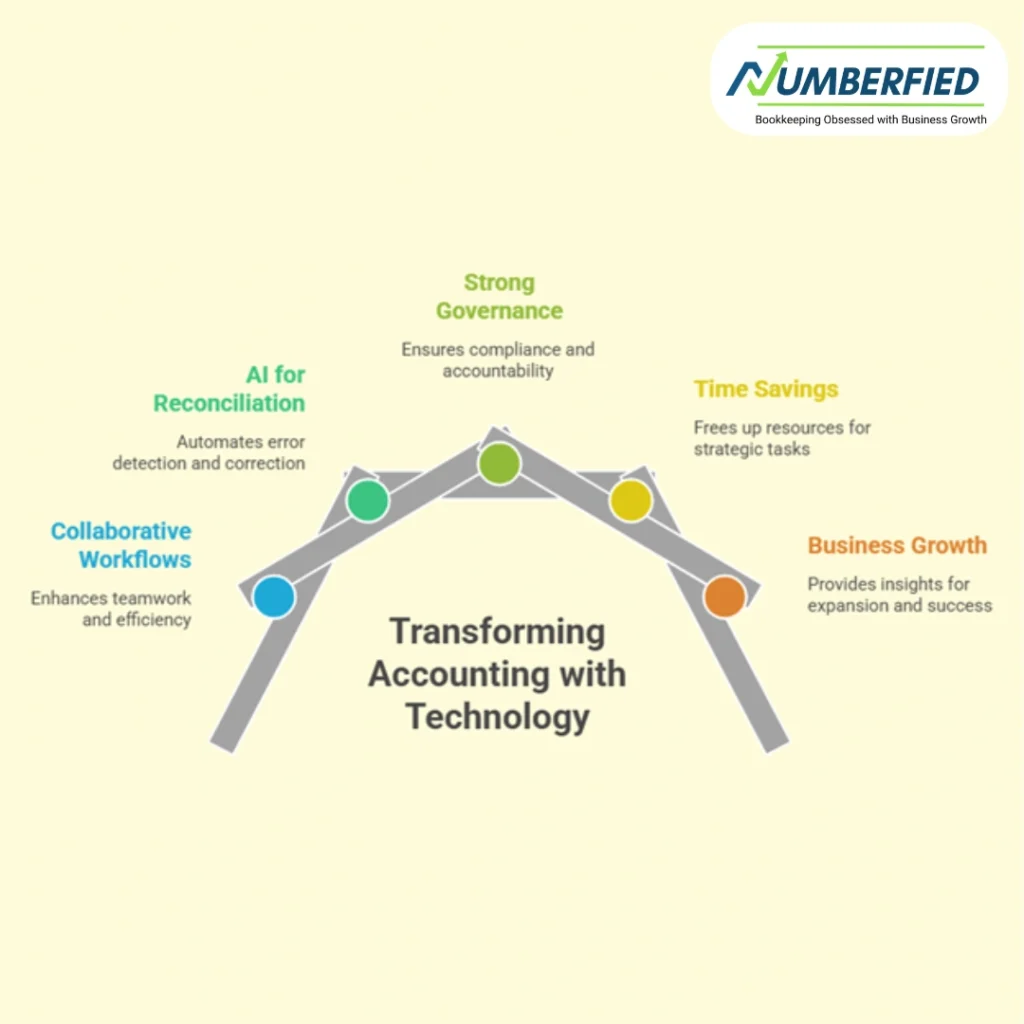
By adopting collaborative workflows, utilizing AI for reconciliation, and maintaining strong governance, you can cut the close cycle from weeks to days and eliminate hours of busywork. The tools available today are designed to give you back your time, allowing you to focus on what truly matters: providing insights that help businesses grow.
Don’t let manual processes define your future. It’s time to automate, elevate, and excel.
Read Also: How Bookkeeping & Accounting Services Can Transform Your Business Growth
Frequently Asked Questions (FAQs)
What exactly is “Accounting Automation”?
Accounting automation refers to using software to handle repetitive tasks such as data entry, invoice generation, bank reconciliation, and expense categorization. I minimize human intervention in standard transactions, allowing staff to focus on analysis and advisory roles.
Will AI replace my job as an accountant?
No. A is designed to be a co-pilot, not a replacement. I handle the “grunt work” (data entry), freeing you to focus on “judgment work” (strategy, forecasting, and client relationships). The role shifts from technician to advisor.
How does automation improve client relationships?
It improves speed and transparency. Clients can track their cash flow in real-time without waiting for month-end reports. I also allows accountants to offer proactive advice rather than just historical reporting, turning a compliance chore into a strategic partnership.
Is automated accounting secure?
Yes, modern platforms prioritize security with bank-level encryption. Furthermore, leading AI systems use a “glass box” approach where every automated action is logged and auditable, ensuring that there is a clear trail of what the system did and who approved it.
What is the “Collaborative Accounting” model?
This is a workflow where the business owner handles the day-to-day, easy-to-use data entry (like sending invoices or uploading receipts), while the accountant handles the complex review, tax adjustments, and financial analysis within the same software ecosystem.
How much time can automation really save?
Significant amounts. Studies show that automation can reduce time spent on bill payment by 70-80% and cut invoice processing costs by over 80%. Some firms report reducing their month-end close from weeks to just a few days.
What is a “Staff Accounting Agent”?
It is a type of AI workflow that mimics a human staff member. I can be trained to take raw data (like spreadsheets of hours worked), combine it with rate cards, and generate formatted journal entries ready for upload into the General Ledger.
Do I need expensive custom software?
No. Most modern cloud accounting platforms (like FreshBooks, QuickBooks, Xero, or Sage) come with built-in automation features or affordable integration tools (APIs) that connect to other apps you already use.
What is the “Zero-Day Close”?
It is the goal of real-time accounting. In a zero-day close scenario, the financial books are always accurate and up-to-date. The formal “closing” process is simply a review of data that has already been processed, rather than a frantic effort to catch up on backlogged entries.
How do I start automating my workflow?
Start small. I identify the biggest time-waster (e.g., bank reconciliation or invoicing). Set up automation rules for that specific task first. Once comfortable, expand to other areas like expense management and payroll integration.
Ready to stop chasing receipts and start building a strategy?
Numberfied connects you with the latest insights and tools to modernize your practice. Contact our team today for a consultation on which automation software fits your firm’s unique needs!