
Introduction
The digital transformation is no longer a distant projection for the financial sector; it is the current reality. Today, the profession is moving rapidly beyond traditional bookkeeping, ledger management, and manual data entry. As automation, cloud-enabled platforms, and generative artificial intelligence become deeply embedded in daily business operations, a profound shift is occurring. Success in the financial landscape is no longer determined solely by a firm grasp of tax codes and compliance; it is dictated by tech fluency and literacy.
For a modern financial practice, technology is not merely a collection of tools used to accelerate standard tasks. Instead, it serves as the foundational infrastructure that determines how financial data is collected, analyzed, and delivered. This evolution does not signal the displacement of human professionals. Rather, it highlights a powerful transition where technical proficiency allows practitioners to step away from repetitive data administration and step into high-value strategic advisory roles. To thrive in this new ecosystem, understanding the distinction between technological literacy and deep technical fluency is the vital first step.
Understanding Tech Literacy vs. Tech Fluency in the Financial Sector
While the terms are often used interchangeably, literacy and fluency represent two distinct stages of technological adoption within the financial sector. Understanding this difference helps practices move from basic survival to true market leadership.
What is Tech Literacy?
Technological literacy is the foundational ability to identify, understand, and utilize digital tools to perform daily tasks. In a professional financial environment, tech literacy looks like:
- Accessing cloud-enabled ledger software to review client transactions.
- Utilizing standard spreadsheet features to organize financial documentation.
- Navigating digital communication portals to securely exchange records with clients.
Literacy is about execution and compliance. It ensures that an individual can follow established digital workflows without disrupting the existing operational structure. It is the absolute minimum requirement to operate in the modern market, but it does not provide a competitive edge.
What is Tech Fluency?
Technological fluency goes significantly deeper. It is the ability to connect disparate digital systems, interpret complex data outputs, and confidently leverage technology to solve abstract business problems. An individual with high tech fluency doesn’t just use an application; they understand how that application fits into a larger, integrated operational ecosystem. In practice, tech fluency enables professionals to:
- Evaluate an existing workflow, identify manual bottlenecks, and design automated sequences to eliminate repetitive data entry.
- Harness generative AI tools to safely analyze large financial data sets, extracting deep trends and predictive anomalies for client forecasting.
- Connect third-party applications via low-code or no-code integration platforms to build a seamless, unified tech stack.
Fluency moves a practitioner from a passive user to an active innovator. When a professional achieves tech fluency, they stop viewing digital tools as a threat to their job security. Instead, they see them as a powerful mechanism that removes administrative burdens, clearing a direct path toward high-level advisory and consulting services.
How Automation and AI Rebrand the Core Value of Accounting
The integration of artificial intelligence and machine learning is fundamentally altering how financial information is processed, analyzed, and leveraged. For decades, the value of a financial professional was tied to accuracy in manual calculation and data organization. Today, advanced algorithms process complex data streams instantly, shifting human value from production to interpretation.
Streamlining Operations with Intelligent Automation
Automation is systematically removing the friction points that traditionally consumed a professional’s billable hours. Processes that once required hours of meticulous manual work are now executed continuously in the background.
- Automated Data Ingestion: Modern systems automatically pull transactional data from bank feeds, point-of-sale platforms, and digital invoicing networks, categorizing information with minimal human intervention.
- Dynamic Client Chasing: Instead of professionals spending hours following up with clients for missing receipts or statements, automated communication workflows handle inquiries systematically, drastically reducing operational downtime.
- Continuous Reconciliation: Real-time ledger updates mean that financial records are always accurate and current, allowing business owners to view their true financial position at any given moment.
By delegating repetitive data collection to automated workflows, firms reclaim substantial administrative time. This time can be directly reallocated toward deep-dive financial analysis and proactive business planning.
The True Role of AI in Financial Advisory
There is a common misconception that artificial intelligence will render financial professionals obsolete. The reality outlined by modern industry analysis is quite the opposite: AI serves as an amplifier of human capability, not a replacement for it.
Artificial intelligence excels at processing raw data, identifying microscopic trends, and flagging structural anomalies across massive data sets. However, AI lacks the contextual awareness, emotional intelligence, and real-world experience required to build deep trust with a business owner. A machine can highlight a projected cash flow dip three months in the future, but it cannot sit down with a client to navigate a sensitive partnership restructuring, interpret market nuances, or offer empathetic guidance through a tough economic season.
The modern objective is to combine data-driven machine insights with the holistic judgment of a skilled advisor. When professionals use AI to handle data ingestion and preliminary forecasting, they can deliver highly accurate, forward-looking insights that help clients optimize profitability and scale operations safely.
Building a Resilient, Tech-Forward Financial Infrastructure
To successfully transition from basic literacy to comprehensive fluency, businesses must actively curate an environment that supports digital agility. This requires a conscious effort to modernize software infrastructure, upskill team members, and implement robust security protocols.
Optimizing the Remote and Hybrid Tech Stack
The modern professional landscape is no longer tied to a centralized physical office. Distributed and hybrid work environments have become standard, requiring a highly resilient, cloud-based infrastructure that ensures seamless internal collaboration and secure client data management.
A truly resilient tech stack relies on native cloud applications that update in real time. This ensures that whether an advisor is working from a corporate office, a home space, or traveling, they are accessing the exact same dataset as the client. Communication tools, task management platforms, and document storage must interlock flawlessly. When data silos are eliminated, operational transparency increases, and the risk of costly miscommunications drops significantly.
Empowering Teams Through Low-Code and No-Code Innovation
One of the most exciting developments in modern business technology is the rise of low-code and no-code tools. Historically, modifying a digital workflow or creating a custom software integration required a dedicated team of software developers. Today, tech-fluent professionals can use intuitive visual interfaces to build custom applications and link independent tools together.
Encouraging teams to explore low-code automation platforms fosters a culture of continuous operational improvement. When an advisor notices a repetitive data-transfer task between two software applications, they have the agency and digital skill to build an automated bridge between those programs themselves. This decentralized approach to innovation allows financial practices to optimize their workflows rapidly, customize client portals, and eliminate operational inefficiencies without waiting for corporate IT intervention.
Prioritizing Advanced Cybersecurity and Data Governance
As financial practices become more integrated with cloud networks and digital applications, they naturally become primary targets for cybercriminals. Financial institutions and advisory firms house complete, high-value financial profiles of individuals and corporations, making data protection a critical business priority.
Achieving digital fluency requires equal proficiency in data security. Firms must implement strict data governance models, including mandatory multi-factor authentication (MFA), zero-trust network access, and end-to-end encryption for all client communications. Furthermore, tech-fluent practices conduct continuous cybersecurity awareness training for their staff.
Understanding how to recognize sophisticated phishing attempts, secure remote home networks, and audit third-party software permissions is just as important as knowing how to interpret a balance sheet. Protecting client data is the bedrock upon which digital trust is built.
Conclusion: Embracing the Future of Financial Management
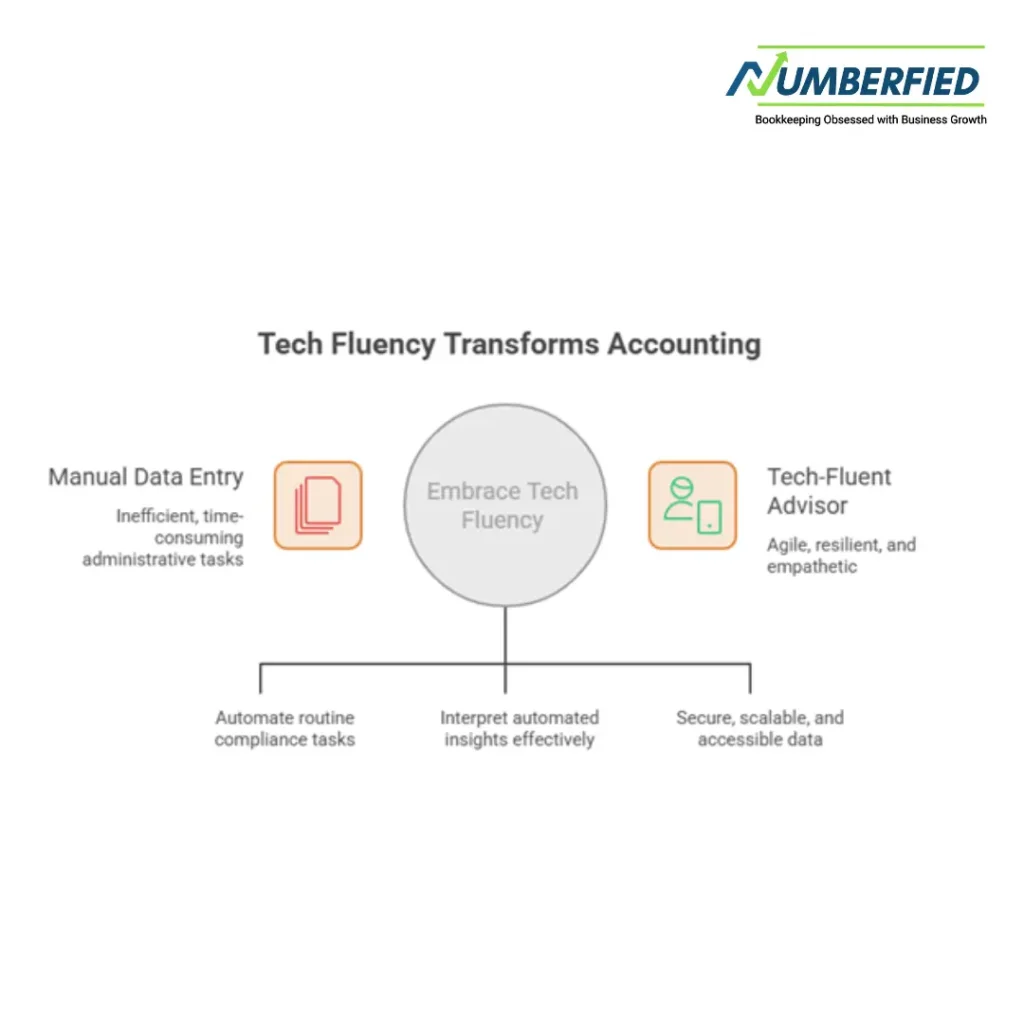
The rapid acceleration of technology should not be viewed as an existential threat to the accounting profession, but rather as an unprecedented invitation to evolve. Tech literacy keeps a practice in the game, but true tech fluency transforms the nature of the work entirely. By actively mastering automation, safely leveraging artificial intelligence, and building secure, cloud-based ecosystems, financial professionals free themselves from the shackles of manual administrative data entry.
The future belongs to the tech-fluent advisor. As routine compliance tasks become fully automated, the true differentiator in the market will be the human element, the ability to interpret automated insights, communicate complex strategies clearly, and forge deep relationships rooted in empathy and trust. Embracing digital fluency ensures that your practice remains agile, resilient, and uniquely equipped to guide businesses through an increasingly complex economic future.
Read Also: Business Accounting in USA Your Guide to Success with Numberfied
Frequently Asked Questions
Will artificial intelligence completely replace human accountants in the future?
No, AI will not replace human accountants. While AI excels at processing high-volume financial data, identifying structural anomalies, and automating routine compliance tasks, it completely lacks human intuition, emotional intelligence, and strategic creativity. The future of accounting relies on a collaborative model where AI handles data processing and human professionals focus on strategic advisory services and client relationship building.
What is the main difference between being tech literate and tech fluent?
Tech literacy means having the basic skills necessary to operate a digital application to complete a specific task, such as entering numbers into cloud ledger software. Tech fluency involves a deeper, holistic understanding of how digital tools connect, allowing a professional to design automated workflows, analyze complex data outputs, and use technology creatively to solve unique business problems.
How does automation benefit small to mid-sized accounting firms?
Automation eliminates highly repetitive, manual administrative tasks such as data entry, bank statement reconciliation, and sending client reminders for documents. By automating these processes, small and mid-sized firms can save multiple hours per employee every week. This reclaimed time allows staff to focus on high-margin strategic consulting, improving overall firm profitability and client satisfaction.
What are low-code and no-code tools, and why should accountants care?
Low-code and no-code tools are software platforms that allow individuals to create custom digital workflows, build simple applications, or integrate separate software systems without needing advanced programming or software development knowledge. They empower tech-fluent accountants to fix operational inefficiencies and build custom data solutions rapidly and independently.
Why are financial practices frequently targeted by cybercriminals?
Financial practices are primary targets because they store comprehensive, highly sensitive data profiles on individuals and businesses, including tax file numbers, banking details, mortgage data, and investment histories. Cybercriminals target these firms because accessing this information provides a high-value leverage point for identity theft, financial fraud, or ransomware demands.
What steps can a traditional firm take to transition its team toward tech fluency?
Firms can start by auditing their current software architecture to remove redundant platforms and encourage team members to experiment with new digital tools. Providing structured training on cloud ecosystems, data analytics, and basic automation platforms, while fostering an open culture that rewards creative problem-solving through technology, will naturally build team confidence and fluency.
How does a strong tech stack improve employee retention in accounting?
Modern professionals, particularly younger accountants entering the workforce, expect to use intuitive, efficient digital platforms. A clunky, outdated tech stack that relies on manual data entry leads to administrative fatigue and frustration. Providing a modern, cloud-based tech stack that supports seamless hybrid work options and reduces tedious manual tasks makes a firm significantly more attractive to top talent.
Can automated software safely handle complex tax compliance issues?
Automated software is exceptionally reliable for organizing financial data, calculating standard deductions, and applying clear-cut tax codes. However, complex tax compliance often involves nuanced business structures, conflicting international regulations, and situational interpretations that require the advanced expertise and qualitative judgment of a seasoned financial professional.
What is continuous reconciliation, and how does it change business operations?
Continuous reconciliation is the practice of automatically syncing and matching transaction data from banks, credit cards, and payment gateways with ledger software in real time. This eliminates the traditional end-of-month scramble, ensuring that business owners and their advisors have access to 100% accurate, up-to-the-minute financial reporting for immediate decision-making.
How should an accounting firm communicate its use of AI and tech to clients?
Firms should frame their tech adoption as a direct benefit to the client. Explain that by utilizing advanced automation and AI tools for data processing, the firm reduces administrative overhead and gains deeper operational insights. This allows the advisor to spend more dedicated, high-value time collaborating face-to-face with the client to strategize for long-term business growth.