
Introduction
The sudden rise of generative artificial intelligence and advanced automation has sent shockwaves through almost every professional industry. When OpenAI first demonstrated the capabilities of GPT-4 by having it prepare a comprehensive tax return, the business world paused. Headlines immediately began questioning the longevity of traditional careers, leaving business owners and financial professionals wondering about the future.
If a software application can process financial data, analyze spreadsheets, and draft documents in seconds, what does the future hold for financial management?
The short answer is simple: automation is not a threat to your business finances or professional financial guidance. Instead, it serves as the ultimate catalyst for growth. While technology can process numbers at lightning speed, it lacks the critical thinking, strategic judgment, and human context required to navigate complex financial landscapes. The modern financial sector is evolving, shifting away from repetitive manual entry and moving toward high-level advisory services that protect and scale business operations.
The Reality of Financial Automation: What AI Can and Cannot Do
To understand why automated systems cannot replace qualified human professionals, it is necessary to examine the actual capabilities and limitations of modern software. The fear of total job replacement stems from a misunderstanding of what artificial intelligence actually does. AI is a pattern-recognition engine, not a conscious thinker.
When implementing automation into business workflows, technology excels at handling highly repetitive, rule-based data tasks. It eliminates human error from routine processing and speeds up backend workflows significantly.
Tasks That Automated Systems Excel At
Modern software platforms are incredibly efficient at handling data-heavy, administrative functions that used to consume hours of manual labor. These include:
- Data Extraction and Categorization: Scanning digital receipts, invoices, and bank statements, then automatically matching transactions to the correct ledger accounts.
- High-Volume Data Analysis: Sifting through thousands of historical financial rows to identify spending patterns, seasonal trends, and anomalies.
- Routine Report Generation: Instantly compiling standard balance sheets, profit and loss statements, and cash flow reports once data is centralized.
- Workflow and Communication Triggers: Automating client reminders for missing documents, tracking outstanding invoices, and drafting basic email templates.
Why the Human Touch Remains Irreplaceable
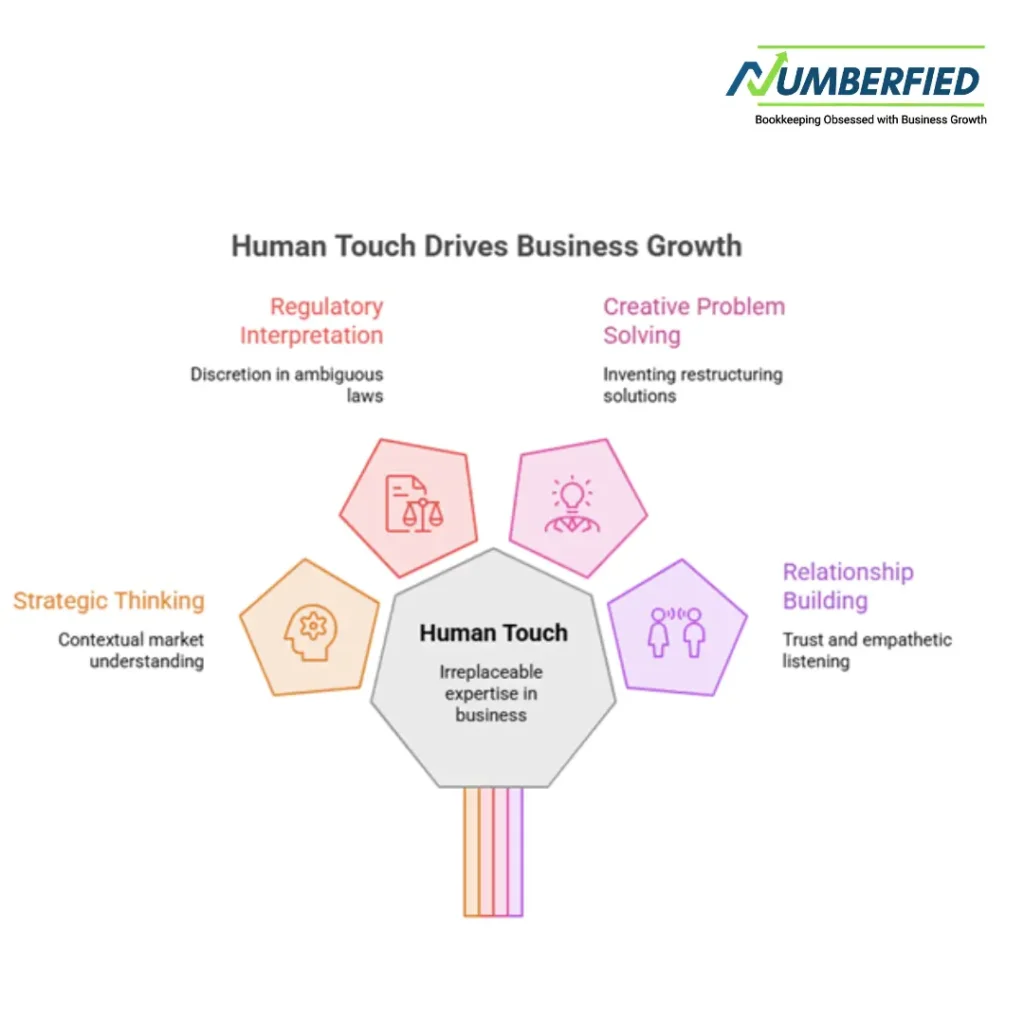
Despite these technical capabilities, automated tools hit a definitive wall when it comes to the real-world complexities of business growth. A software program can read numbers, but it cannot understand a business owner’s long-term vision. The following core areas remain completely dependent on human expertise:
- Contextual and Strategic Thinking: AI looks at historical data in a vacuum. It does not know if a local market is shifting, if a business owner is planning a massive expansion, or how to structure financing for an acquisition based on personal relationships.
- Regulatory Interpretation and Ethics: Tax laws and compliance structures are rarely black and white. Human professionals must exercise discretion, interpret ambiguous regulations, and make judgment calls that protect a business from legal risks.
- Creative Problem Solving: When a business faces a sudden cash flow crunch or unexpected economic downturn, software cannot invent creative restructuring solutions or negotiate custom payment terms with suppliers.
- Relationship Building and Trust: Financial data is deeply sensitive. Business leaders do not just want automated outputs; they require reassurance, empathetic listening, and a trusted advisor who understands their personal goals and anxieties.
How Automation Empowers Accountants to Deliver Greater Value
Technology has a long history of transforming professions without destroying them. When digital spreadsheets replaced physical paper ledgers, critics claimed the financial industry would collapse. Instead, it boomed. The introduction of calculators did not eliminate mathematicians; it simply allowed them to solve more complex problems faster.
The integration of automation follows this exact historical pattern. By removing the burden of manual administrative work, technology frees up professionals to focus on deep, impactful financial strategy.
Shifting from Data Processors to Trusted Advisors
In the past, a significant portion of financial management involved data entry, clearing bank feeds, and manually reconciling accounts. Automation changes the entire dynamic of professional service.
When software handles the foundational data collection, human experts spend less time looking backward at historical data and more time looking forward. They transition into strategic partners who help businesses optimize their tax structures, improve profit margins, manage inventory levels, and identify hidden operational inefficiencies.
Leveraging Modern Tools for Maximum Efficiency
Rather than working against technology, top-tier accounting firms and financial teams are actively embedding AI into their daily operations to maximize productivity. According to recent industry data, professional teams are using automation to streamline three primary areas:
- Communication and Correspondence: Utilizing generative text tools to draft fast, accurate email updates, summarize long communication threads, and explain complex financial concepts in accessible language.
- Workflow Management: Setting up autonomous tracking systems that monitor project deadlines, assign internal tasks, and flag missing documentation automatically.
- Meeting Synthesis: Using automated transcription tools to log strategy sessions, pull out key action items, and instantly deliver clear summaries to business stakeholders.
When an organization embraces an automated workflow, overall operational capacity increases. Teams can manage more accounts with higher accuracy, ensuring that no details slip through the cracks while maintaining absolute compliance.
Navigating the New Era of Business and Financial Management
As a business owner, navigating this technological shift requires a proactive approach. The goal should never be to choose between human expertise and automated efficiency. The most successful organizations utilize a combined approach: advanced software to handle the data foundation, paired with human professionals to drive the strategy.
To stay competitive in a rapidly evolving market, businesses must understand how to align their internal processes with modern automated capabilities.
Establishing Clear Software and Data Policies
As automation tools become more accessible, data security and accuracy must remain top priorities. Automated tools can occasionally generate incorrect outputs or misinterpret nuanced data points- a phenomenon often referred to as software hallucination.
Organizations must implement strict verification protocols. Every automated financial report, tax draft, or data export must be reviewed and validated by a qualified professional before any critical business decisions are made. Furthermore, strict privacy guidelines must be established to ensure sensitive corporate and client data is never uploaded into insecure, public AI models.
Enhancing Communication with Clients and Stakeholders
Transparency is vital when integrating automated systems into your business framework. Clients and partners want to know how their data is handled and where human oversight takes over.
Forward-thinking organizations take complete control of this narrative by openly discussing their technology stack. By publishing clear privacy policies, sharing insights on how automation improves service delivery, and demonstrating how technology allows for more dedicated one-on-one strategy time, businesses build deeper trust and authority in their market.
Ultimately, the rise of automation represents a massive opportunity to do better, more polished work at an accelerated pace. Technology handles the math, but humans handle the meaning. By embracing automation as an operational partner, businesses can secure their financial foundations and unlock new pathways for scalable, long-term success.
Conclusion
The evolution of artificial intelligence and workflow automation does not signal the end of the financial professional. Instead, it marks the beginning of an era centered on elevated advisory services. Automated tools are exceptional at managing speed, data volume, and repetitive administrative workflows, but they will never possess the human empathy, ethical judgment, and creative problem-solving skills that business owners rely on during pivotal moments of growth.
The future belongs to a collaborative model where technology acts as the infrastructure and human intelligence acts as the architect. By automating the routine, businesses can unlock the true potential of professional financial guidance, turning complex data into actionable strategies that drive real-world success.
Read Also: Business Accounting in USA Your Guide to Success
FAQs
Will artificial intelligence completely replace human accountants?
No. While AI can automate repetitive tasks like data entry, reconciliation, and basic report generation, it cannot replace the critical thinking, ethical judgment, strategic forecasting, and client relationship management that human professionals provide.
What are the main benefits of financial automation for small businesses?
Automation reduces manual data entry errors, accelerates financial reporting, lowers administrative costs, and provides real-time visibility into cash flow. Most importantly, it gives business owners cleaner data to make informed decisions.
Can ChatGPT accurately prepare and file a corporate tax return?
No. While tools like ChatGPT can analyze data sets or draft template forms based on specific prompts, they cannot accurately interpret ambiguous tax laws, adapt to changing local regulations, or provide the certified oversight required for legal compliance and auditing purposes.
How do modern accountants utilize AI to improve their services?
Professional teams use AI to transcribe client meetings, summarize long email chains, draft client communications, flag missing time entries, and automate document collection workflows, allowing them to spend more time on direct advisory services.
Is financial data safe when using third-party automation tools?
Data safety depends entirely on the security protocols of the specific tool and how it is implemented. Businesses should only utilize enterprise-grade software with robust encryption, explicit data-privacy policies, and compliance with local financial regulations. Public, unsecured AI models should never be used with sensitive financial records.
What tasks should a business automate first in its financial department?
The easiest and most impactful tasks to automate first include digital receipt collection, invoice matching, automated payment reminders for clients, and bank feed reconciliations.
Does automation mean I need less financial oversight in my company?
The opposite is true. While automation reduces the time spent on manual processing, it increases the need for high-level analytical oversight to ensure the automated outputs are correct, compliant, and properly aligned with business objectives.
How can I tell if a financial software tool uses reliable AI features?
Look for software built specifically for the financial sector that integrates with established accounting platforms. Reliable tools will have transparent documentation, strong data processing agreements, and positive reviews from verified industry professionals.
Will software automation make traditional accounting services cheaper?
Automation typically shifts pricing models away from hourly billing for manual entry and toward value-based pricing for strategic advisory services. You may spend less on basic data processing, but the value lies in the actionable insights provided by professional analysis.
How should a business prepare its team for the transition to automated workflows?
Businesses should focus on upskilling their teams, training them to use modern software platforms effectively, emphasizing data verification techniques, and shifting internal goals toward strategic interpretation rather than raw data production.