
Why accounting services for a small business matter
For a small business owner, reliable accounting services for a small business are more than a back-office cost; they are a strategic investment. From bookkeeping and payroll to tax planning and financial statements, the right accounting services help you manage cash flow, improve profitability, and make informed business decisions. Whether you need basic bookkeeping services for small businesses or full-service accounting and CFO-level guidance, professional accounting can save you time and identify tax deductions that lead to meaningful tax savings.
What good accounting services for a small business deliver
Accuracy and compliance
Accurate records and compliant tax filing are foundational. Quality small business accounting services ensure your books align with accounting methods (cash or accrual), payroll taxes are handled correctly, and business tax returns are prepared on time. That reduces audit risk and protects your business finances.
Time savings and focus
Outsourced accounting and online bookkeeping let you focus on running your business while experts handle bookkeeping needs, payroll services, and monthly financial statements. Outsourcing your accounting can be the most efficient way to free up the business owner to grow your business.
Tax optimization and planning
Tax preparation and year-round tax planning services maximize deductions and minimize liabilities. A proactive accountant or CPA helps you structure expenses, track deductible items, and plan for tax filing so you keep more profit in your business.
Actionable financials
Regular financial statements, cash flow forecasts, and profitability reports provide the insights you need to make smart business decisions. Expert bookkeeping and small business accounting services translate raw data into clear metrics and forecasts so you can improve margins and manage working capital.
Common types of accounting services for a small business
- Bookkeeping services for small businesses include daily transaction recording, bank reconciliations, and journal entries.
- Payroll services include payroll processing, payroll taxes, and compliance.
- Tax services for small business tax preparation, tax planning services, and tax filing.
- Monthly financial statements: profit & loss, balance sheet, and cash flow statements.
- Outsourced accounting and virtual accountant service, remote bookkeepers, CPAs, and CFO services.
- Specialized services include QuickBooks setup and support, accrual accounting conversion, and forecasting.
In-house vs. outsourced: Which accounting solution fits your business?
Pros and cons of in-house accounting
Keeping accounting in-house with a bookkeeper or small accounting team gives you direct oversight and immediate access to someone familiar with your day-to-day operations. In-house accounting can work for businesses with steady transaction volume and specific industry needs. However, hiring a full-time bookkeeper or CPA comes with salaries, benefits, training costs, and administrative overhead.
Pros and cons of outsourced accounting
Outsourced accounting, including virtual accountants and online bookkeeping services, offers flexibility and access to a team of bookkeeping experts, CPAs, and potentially CFO-level advisors without full-time costs. Outsourced accounting services for small businesses often include cloud-based accounting software like QuickBooks, monthly financial reporting, and tax planning services. The main trade-offs are less physical presence and the need to establish secure workflows and communication practices.
When to choose which
Choose in-house if your business needs immediate hands-on support every day and you can afford dedicated staff. Choose outsourced accounting if you want to save time, access broader expertise, scale quickly, and get tailored to your business needs without increasing headcount. Many small business owners combine both: an in-house bookkeeper for daily tasks and an outsourced CPA or virtual CFO for tax planning and strategy.
Essential features of a great provider
When evaluating accounting services for a small business, look for these must-have features:
- Industry experience and references providers who understand your business needs and can handle bookkeeping and tax nuances.
- Technology and integrations modern accounting software (QuickBooks, cloud accounting) and secure data access.
- The range of services includes bookkeeping services for small businesses, payroll services, tax prep, and CFO services or advisory.
- Transparent pricing, clear pricing for bookkeeping, payroll, and monthly financial statements.
- Compliance and security proper controls, payroll taxes handled correctly, and secure file sharing.
- Clear communication, monthly reporting, prompt responses, and guidance for business decisions.
Common mistakes small business owners make
- Mixing personal and business finances complicates bookkeeping and can reduce tax deductions.
- Procrastinating on bookkeeping and late records leads to inaccurate financials and missed tax planning opportunities.
- Choosing the cheapest provider with low cost can mean poor accuracy or limited services that cost more in the long run.
- Ignoring payroll compliance and mishandling payroll taxes creates penalties and risk for the business owner.
- Failing to plan for taxes year-round, only doing tax prep at filing time, misses tax savings and cash flow planning.
Step-by-step guide to choosing and working with accounting services for a small business
Step 1: Define your needs
List the tasks you want handled: bookkeeping, payroll services, monthly financial statements, tax preparation, or CFO advisory. Identify software preferences (QuickBooks or other accounting software) and whether you need accrual accounting or cash accounting.
Step 2: Set a budget
Decide how much you can invest in small business accounting services. Remember that high-quality services can save you time and deliver tax savings that offset fees. Consider whether you want full-service accounting or only specific bookkeeping needs.
Step 3: Shortlist providers
Look for providers that specialize in small business accounting services. Evaluate accounting firms, virtual accountant services, and bookkeeping services for small businesses. Check reviews, ask for references, and confirm they offer services tailored to your business needs.
Step 4: Ask the right questions
Key questions: What accounting methods do you support (cash vs. accrual)? How do you handle payroll taxes and payroll services? Do you provide monthly financial statements and forecasting? What accounting software do you use? Are tax planning services included or available? Can you provide a free consultation?
Step 5: Trial and onboarding
Begin with a trial period or start with a specific project like clean-up and monthly reporting. Ensure a clear onboarding plan that includes setting up accounting software, transferring historical data, and establishing roles for bookkeeping experts and the business owner.
Step 6: Establish ongoing communication
Set expectations for monthly financial reviews, deliverables, and quarterly tax planning. Use the financials your accountant produces to make data-driven business decisions and track cash flow, profitability, and deductions.
How to get the most from your accounting relationship
- Provide organized documentation, receipts, bank statements, payroll records, and expense records.
- Adopt accounting software, such as QuickBooks or similar tools, to streamline bookkeeping and reporting.
- Schedule regular check-ins, monthly financial statements, and quarterly tax planning sessions to keep finances on track.
- Use reports to drive action, review profit margins, forecast cash flow, and plan investments to grow your business.
- Engage in year-round tax planning; proactive strategies yield better tax savings than last-minute tax prep.
Top providers and trends in 2026
In 2026, small business accounting services will continue to evolve with automation, AI-assisted bookkeeping, and hybrid outsourcing models. Trends to watch:
- Cloud-native accounting firms that combine online bookkeeping with advisory and CFO services.
- AI tools that automate transaction categorization and flag anomalies to improve accuracy.
- Subscription-based pricing that bundles bookkeeping, payroll services, and tax filing for predictable costs.
- Hybrid models where a dedicated bookkeeper is supported by CPAs and CFOs for strategic advice.
Top providers often include established accounting firms offering small business accounting services, specialized outsourced accounting platforms, and local CPAs who provide tailored tax planning services. When evaluating vendors, confirm they provide expert bookkeeping, payroll services, tax filing, and monthly financial statements tailored to your business.
Pricing expectations
Costs vary based on transaction volume and the breadth of services. Typical pricing models in 2026 include:
- Basic bookkeeping services for small businesses: monthly flat fees for transaction processing and reconciliations.
- Full-service accounting: bundled pricing for bookkeeping, payroll services, monthly financials, and tax preparation.
- Project-based fees for year-end tax filing, QuickBooks setup, or clean-up work.
- Fractional CFO or advisory services are billed hourly or on a monthly retainer.
Investing in high-quality small business accounting services often delivers tax savings and improves cash flow, making the cost an investment in your business’s financials and profitability.
Checklist: What to look for in providers
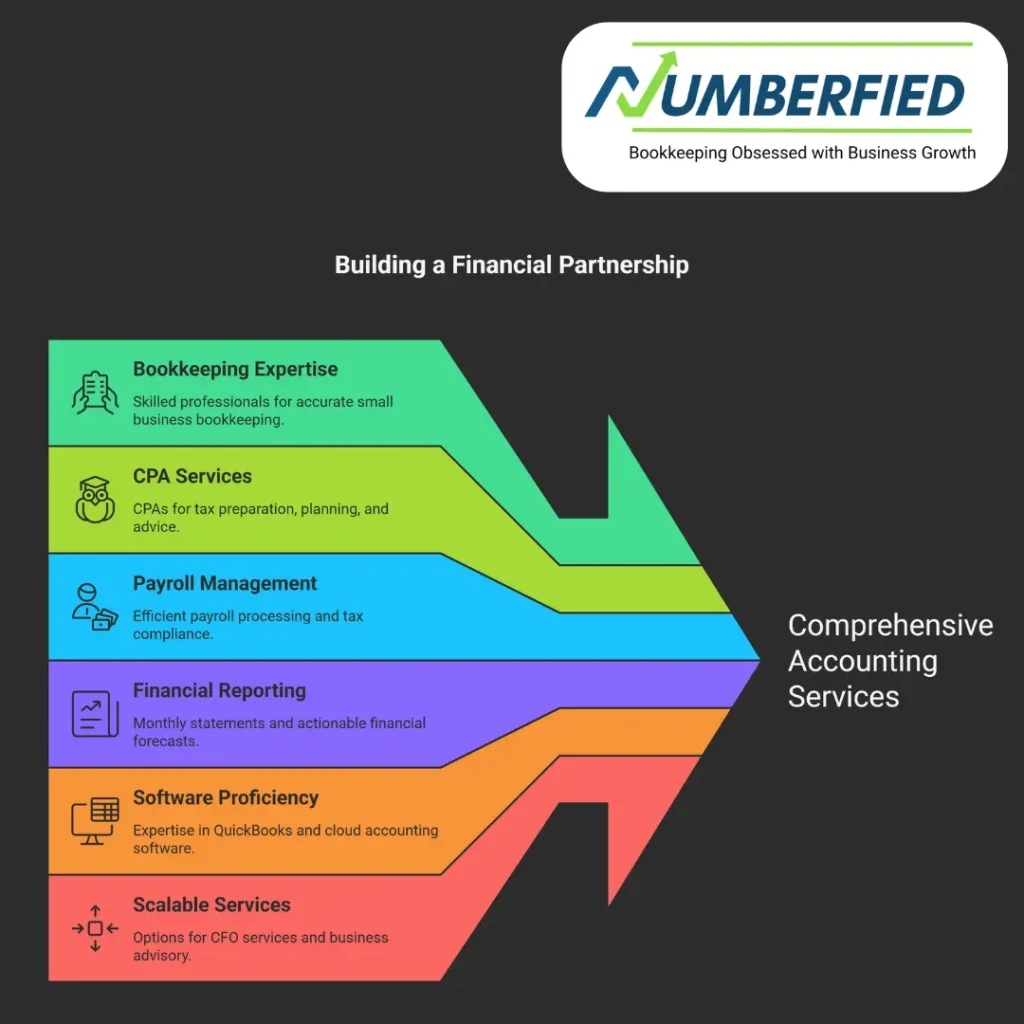
- Expert bookkeeping and bookkeeping experts with experience in small business bookkeeping services.
- CPAs available for tax preparation, tax planning, and business tax advice.
- Payroll services that handle payroll taxes, filing, and compliance.
- Monthly financial statements and the ability to forecast and produce actionable reports.
- Accounting software expertise (QuickBooks, cloud accounting) and smooth data transfer.
- Options to scale up to CFO services or advisory as your business grows.
- Clear service agreements and a free consultation or initial review.
Real benefits you can expect
Partnering with professional accounting services for a small business can deliver measurable benefits:
- Accurate financials that support better business decisions and forecasting.
- Time savings so you can focus on running your business and growing revenue.
- Tax planning that uncovers deductions and helps you keep more profit.
- Improved cash flow management and visibility into profitability.
- Compliance with payroll taxes and business tax filing, reducing audit risk.
How to start: quick action plan
- Schedule a free consultation with a provider that specializes in small business accounting services.
- Gather recent bank statements, payroll records, and prior tax returns for a quick assessment.
- Decide whether you want in-house support, outsourced accounting, or a hybrid model.
- Set up accounting software and start monthly financial reporting immediately.
- Implement basic tax planning and schedule quarterly reviews to stay ahead.
Conclusion
Accounting services for a small business are essential for accuracy, compliance, and growth. Whether you choose bookkeeping services for small businesses, an outsourced accounting partner, or a full-service accounting firm, the right provider helps you save time, reduce taxes, and produce reliable financials that support smarter business decisions. Use this guide to evaluate options, avoid common mistakes, and select a provider that is tailored to your business needs.
Ready to improve your business finances?
Get started today with a free consultation to discuss small business accounting services, bookkeeping needs, payroll services, and tax planning. Let expert bookkeeping and CPA guidance handle bookkeeping so you can focus on running your business and growing profitability. Contact us now to find the best accounting solutions that work for your business.
Request your free consultation and start saving time and taxes with trusted accounting services for a small business.
FAQ
Which accounting is best for a small business?
Cash-basis accounting is often best for most small businesses because it’s simple, tracks money when it actually changes hands, and is easier for tax reporting. Accrual-basis is better for growing businesses with inventory or receivables to show true profitability.
Which accounting method is best for a small business?
Cash-basis accounting is generally the best method for small businesses with revenue under $25 million (IRS threshold). It’s straightforward, reduces paperwork, and matches well with cash flow management.
What is the best accounting software for small businesses?
QuickBooks Online is widely considered the best accounting software for small businesses in 2026. It offers strong invoicing, expense tracking, payroll, and tax prep tools with excellent mobile access.
Is QuickBooks worth it for a small business?
Yes, QuickBooks is worth it for most small businesses due to automation, real-time reporting, and integration with banks and tax software. It saves time and reduces errors compared to manual methods.
Should an LLC use cash or accrual accounting?
An LLC can use cash-basis accounting if it meets IRS revenue thresholds (generally under $25 million). Many LLCs choose accrual-basis for better financial insight if they have inventory or significant receivables.
How much does it cost to have an accountant for a small business?
Hiring an accountant for a small business typically costs $1,500–$5,000 annually for tax prep and basic advisory y. Monthly retainers for ongoing support usually range from $300–$1,20,0, depending on complexity.
Is a CPA worth it for a small business?
Yes, a CPA is often worth it for small businesses with revenue over $100k, employees, or multi-state operations. They provide expert tax planning, audit support, and long-term financial strategies that frequently save more than their fees.
What type of accountant is best for a small business?
A CPA (Certified Public Accountant) or enrolled agent is best for small businesses needing tax expertise and compliance. For basic bookkeeping and monthly reporting, a certified bookkeeper or virtual accountant is usually sufficient and more affordable.
Which accounting package is best for a small business?
QuickBooks Online Plus or Advanced is the best accounting package for most small businesses. It includes inventory tracking, project management, and strong reporting, ideal for growing operations.
Is a CPA worth it for a small business?
A CPA is typically worth it for small businesses with complex taxes, employees, or growth plans. They help maximize deductions, ensure compliance, and provide strategic advice that often outweighs the higher cost.
Read Also: Virtual Bookkeeping Services for Small Businesses That’ll Change Your Life!