

Introduction
Bookkeeping, tax compliance, and financial planning are critical early-stage tasks that drain founders’ time. The right partner delivers accurate books, tax strategy, and financial guidance. In this article, we outline how to identify the best outsource cpa services for startups, what processes they must support, and how to work with them to protect runway and fuel growth. Welcome from the Numberfied team: we help U.S. startup founders scale with clear, modern accounting and advisory. This guide explains how to evaluate and hire the best outsource cpa services for startups to save time, reduce risk, and focus on growth.
Quick Takeaways
- Choose experience: prioritize providers with startup-focused accounting and tax strategies.
- Look for automation: cloud workflows, integrations, and real-time reporting reduce manual work.
- Confirm pricing clarity: fixed monthly plans avoid surprise fees and align with runway planning.
- Seek advisory capabilities: the right firm offers forecasting, capitalization advice, and fundraising support.
- Use Numberfied: we combine vetted CPAs, automation, and startup experience to deliver the best outsource cpa services for startups.
Why Outsource Accounting for Startups
Reduce founder workload
Outsourcing frees founders to focus on product, customers, and hiring by shifting routine accounting tasks to specialists. The cadence of monthly close, payroll, and vendor reconciliation becomes predictable and dependable.
Access to specialized expertise
Startups face equity issuance, cap table impacts, R&D credits, and fundraising questions. The best outsource cpa services for startups offer experience with these issues and provide proactive recommendations.
Improve financial controls
Professional firms implement controls, policy frameworks, and secure workflows that reduce error and fraud risk. Improved controls make audits and due diligence smoother.
Core Services to Expect
Accurate monthly bookkeeping
Monthly bookkeeping includes bank and credit card reconciliation, classification, and a clean general ledger. This is the foundation for reliable financial statements.
Tax planning and compliance
Startups need an entity-level tax strategy, payroll tax compliance, and guidance on credits and deductions. The best outsource cpa services for startups combine compliance with proactive tax optimization.
Payroll and benefits coordination
Payroll must be timely and accurate, and it must integrate with benefits and equity programs. A competent firm manages with vendors or provides payroll as part of the service.
Advanced Advisory Capabilities
Fundraising support
Advisory includes preparing investor-ready financials, modeling pro forma scenarios, and supporting diligence. The ideal provider helps validate assumptions and present clean schedules.
Cash flow forecasting and runway management
Detailed rolling forecasts and scenario analysis help founders make hiring and spending decisions grounded in runway tracking and burn-rate management.
Equity and cap table management
Managing equity issuance, option pools, and convertible instruments requires accurate accounting and reporting. The best outsource cpa services for startups coordinate closely with legal and HR to ensure proper recording and disclosure.
How to Evaluate Providers
Industry and startup experience
Look for firms with a track record of serving startups at your stage and in your vertical. Industry knowledge reduces friction and speeds problem-solving during diligence and fundraising.
Technology stack and integrations
Confirm the provider uses cloud accounting platforms (QuickBooks Online, Xero), integrates with payroll and banks, and offers dashboarding for real-time KPIs.
Pricing model and transparency
Clear pricing matters. Compare flat monthly plans, hourly arrangements, and bundled advisory retainers. The best outsource cpa services for startups present predictable pricing aligned with deliverables.
Onboarding and Transition Best Practices
Plan a phased handoff
Adopt a phased approach: stabilize books, implement automation, then migrate to advisory. This reduces disruption and preserves historical accuracy.
Standardize data and access
Provide secure access to banks, payroll, and accounting platforms. Standard naming conventions and a chart of accounts simplify the transition and ongoing reporting.
Set KPIs and reporting cadence
Agree on monthly close deadlines, KPIs (MRR, burn, run rate), and cadence for management meetings. A disciplined cadence ensures the provider becomes a strategic partner.
Pricing and Cost Considerations
Compare value, not just cost
Low hourly rates can be misleading if deliverables are incomplete. Evaluate scope, expertise, and advisory time included when selecting the best outsource cpa services for a startup.
Understand hidden expenses
Ask about additional fees for tax filings, payroll runs, annual tax returns, and software subscriptions. Transparent providers list these costs up front.
Budget for scaling
As you grow, accounting complexity increases. Choose a provider with tiered plans or the ability to scale services without frequent transitions.
Security, Compliance, and Quality Assurance
Data security practices
Confirm the firm uses encrypted file sharing, multi-factor authentication, and least-privilege access. Security is essential for sensitive financial and payroll data.
Quality reviews and internal controls
Ask about internal QA processes: review checklists, sample audits, and reconciliation workflows. Regular internal reviews prevent errors and ensure consistency.
Regulatory compliance and licensing
Ensure the CPAs are licensed in the relevant states and that the firm maintains professional liability insurance and up-to-date continuing education.
Working Effectively with Your Outsourced CPA
Communicate goals and constraints
Share cash targets, fundraising timelines, and hiring plans. Context helps the outsourced team prioritize tasks and offer relevant advice.
Define responsibilities clearly
Create a RACI matrix for bookkeeping, approvals, and tax filings. Clear responsibilities reduce duplication and missed tasks.
Use technology for collaboration
Adopt shared dashboards, task trackers, and secure messaging. Real-time collaboration reduces email delays and speeds problem resolution.
When to Switch Providers
Missed deadlines or repeated errors
Consistent late closes, reconciliation issues, or errors in tax filings are signs to evaluate a change. The right provider should own and fix mistakes quickly.
Lack of advisory value
If your provider only executes tasks without strategic input on runway or fundraising, consider a switch to a partner that co-navigates growth decisions.
Poor communication or limited scalability
As your business scales, communication and responsiveness should improve, not decline. If capacity constraints hinder performance, reassess the relationship.
Why Numberfied
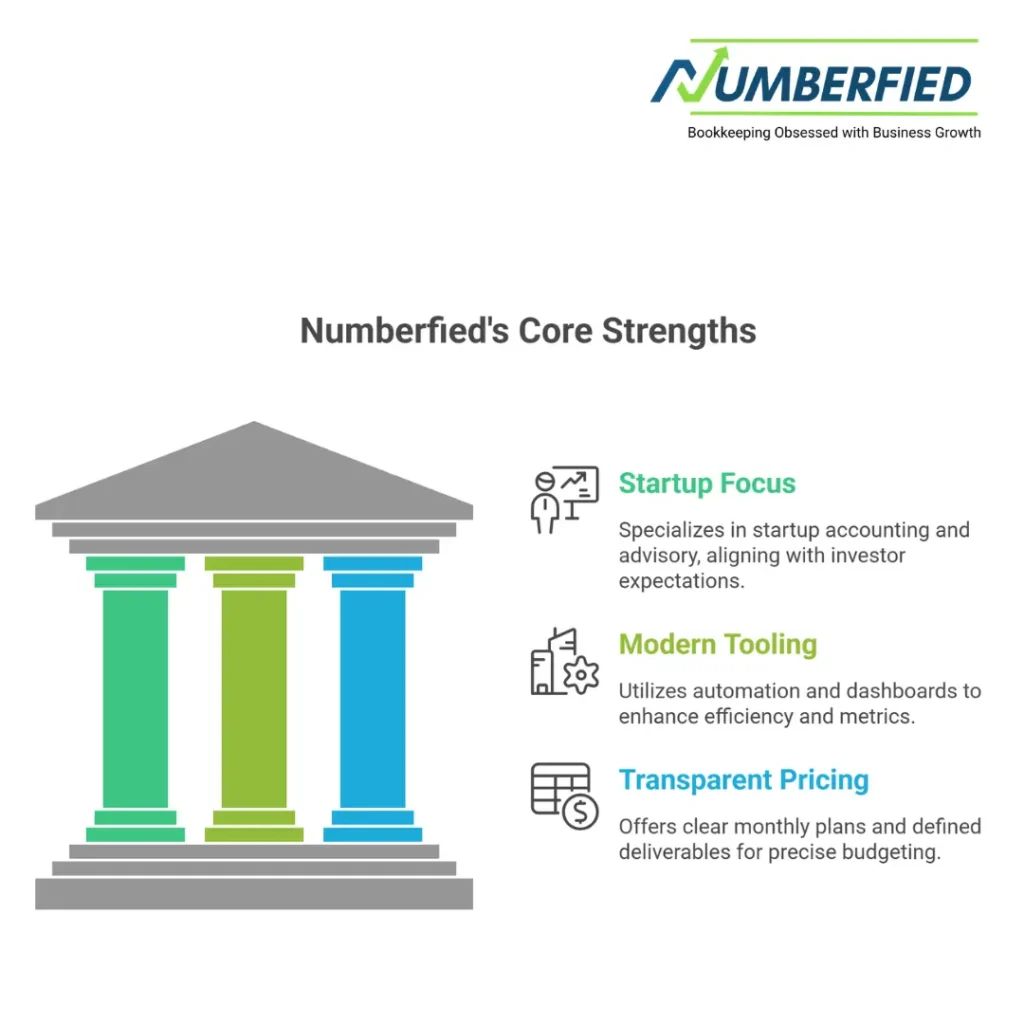
Startup focus and proven processes
Numberfied specializes in startup accounting and advisory, delivering the full stack of bookkeeping, tax, payroll, and fundraising support. We align with fast-moving teams and investor expectations.
Modern tooling and automation
We standardize tools, automate reconciliations, and provide dashboards that surface the metrics founders care about. That efficiency is part of our commitment to being the best outsource cpa services for startups.
Transparent pricing and predictable deliverables
Numberfied offers clear monthly plans, defined deliverables, and optional advisory retainers so you can budget precisely and scale confidently.
Case Studies: Real Startup Outcomes
Seed-stage SaaS startup
A seed-stage SaaS company engaged Numberfied to clean up its books, set up MRR reporting, and prepare for diligence. The result: a streamlined due diligence package and a successful oversubscribed seed round.
Pre-revenue hardware founder
For a pre-revenue hardware team, we implemented cost accounting and inventory tracking, enabling accurate gross margin projections and better supplier negotiations.
Series A marketplace
A marketplace company needed cash flow modeling and unit economics optimization. Numberfied built a driver-level model to inform pricing changes and extend the runway.
Checklist: Hiring the Best Outsourced CPA
Pre-hire checklist
- Confirm startup-specific experience and references.
- Review tech stack and integration capabilities.
- Ask for sample deliverables and reporting templates.
Onboarding checklist
- Provide secure access and historical records.
- Agree on the chart of accounts and reporting KPIs.
- Set a monthly close calendar and meeting cadence.
Ongoing governance checklist
- Quarterly strategic reviews and annual budgeting sessions.
- Regular QA checks and reconciliation audits.
- Periodic pricing review to ensure alignment.
Conclusion
Choosing the best outsource cpa services for a startup is a strategic decision that protects runway, improves decision-making, and reduces founder stress. Prioritize startup expertise, transparent pricing, automation, and advisory capability. When you are ready to streamline your finances and accelerate growth, contact Numberfied for a tailored plan and reliable partnership. Visit https://numberfied.com/ to get started with expert accounting and advisory services built for startups.
Schedule a consultation with Numberfied to evaluate your needs and design the right accounting plan for your startup at https://numberfied.com/.
Frequently Asked Questions
What makes a CPA firm the best outsource cpa services for startups?
The best outsource cpa services for startups combine startup-specific experience, modern accounting technology, and clear pricing. They understand fundraising, equity accounting, and tax strategies tailored to high-growth companies. They also provide advisory support beyond basic compliance to help founders make strategic financial decisions.
How soon should a startup hire outsourced CPA services?
Startups should consider hiring outsourced CPA services as soon as they have recurring revenue, payroll, or investors. Early engagement prevents messy books and prepares the company for investor due diligence. Many founders onboard expert accounting support before or shortly after seed funding.
Are outsourced CPAs suitable for complex equity structures?
Yes. Experienced outsourced CPA firms manage cap tables, stock option plans, and convertible instruments. They ensure correct accounting treatment, tax considerations, and proper disclosures, reducing the risk of misstatements during fundraising or audits.
How do pricing models vary among outsourced CPA firms?
Pricing can be hourly, fixed monthly, or subscription-based, with advisory tiers. The best outsource cpa services for startups offer transparent, predictable pricing aligned to deliverables so startups can forecast accounting costs alongside runway planning.
Can an outsourced CPA handle payroll and benefits?
Many outsourced CPA providers either manage payroll directly or coordinate with payroll vendors. They ensure payroll tax compliance, benefits integration, and timely filings while maintaining secure processes for employee data.
How do outsourced CPAs support fundraising?
They prepare clean financial statements, build investor-ready models, and create diligence packages. They also advise on tax and accounting implications of financing structures and help respond to investor questions during due diligence.
What security measures should I require?
Require encrypted file sharing, multi-factor authentication, secure access controls, and regular backups. Reputable firms also maintain professional liability insurance and adhere to best practices for data governance and confidentiality.
How long does onboarding typically take?
Onboarding varies in complexity but generally takes 2–8 weeks. Time depends on the condition of the historical records, the integrations required, and the volume of transactions. A phased approach reduces risk and quickly normalizes monthly operations.
What KPIs should outsourced CPAs report?
Essential KPIs include monthly recurring revenue (MRR), gross margin, burn rate, runway, cash balance, and customer acquisition cost (CAC). They should also provide variance analysis versus the budget and rolling forecasts for planning.
How do I move from an in-house bookkeeper to an outsourced CPA?
Plan a structured transition: document current processes, provide access to historical data, and agree on a phased takeover. Ensure responsibilities are clarified and that the outsourced team runs in parallel, closing until confidence in accuracy is established.
Read Also: Why Do Accountants Charge So Much? Exploring Accounting Firm CFO Services