
Introduction
Managing finances well is a cornerstone of a successful real estate practice. This guide explains bookkeeping for realtors in clear, actionable steps so you can reduce stress, increase profitability, and focus on clients. Below you’ll find key takeaways, a step-by-step framework, and specific ways Numberfied can support your back office.
Key Takeways
- Why bookkeeping matters for real estate professionals
- How to set up efficient systems and workflows
- Tax preparation, compliance, and profitability insights
- When to hire a specialist or outsource to Numberfied
Understanding Bookkeeping Fundamentals for Realtors
What bookkeeping for realtors actually means
Bookkeeping for realtors is the consistent recording of income, expenses, liabilities, and assets related to real estate transactions and brokerage operations. It captures commissions, referral fees, advertising costs, client trust activity, and overhead.
Core bookkeeping concepts realtors must master
Realtors need to be familiar with revenue recognition for commissions, expense categorization, accounts receivable and payable, bank reconciliations, and profit and loss statements. Accurate bookkeeping for realtors prevents misclassification that can lead to tax issues or misleading profitability reports.
Key documents and records to keep
Maintain transaction ledgers, commission statements, receipts for business expenses, escrow and trust records, bank statements, and loan documents. Trust accounting often requires its own ledgers as part of a realtor’s bookkeeping to remain compliant with state regulations.
Setting Up an Efficient Bookkeeping System
Choose the right accounting software
Select cloud-based accounting software that supports integrations with MLS platforms, CRM systems, payment processors, and bank feeds. The right software streamlines bookkeeping for realtors by automating data entry and reducing errors.
Create a consistent chart of accounts
A tailored chart of accounts for real estate professionals helps separate personal and business transactions, differentiate brokerage versus agent income, and clarify tax-reporting categories. Standardized accounts simplify bookkeeping for realtors and make reporting predictable.
Establish workflows and responsibilities
Define who is responsible for invoicing, entering transactions, reconciling accounts, and reviewing reports. Whether you are an independent agent or run a small brokerage, documenting these tasks improves consistency and accountability in realtors bookkeeping.
Recording Transactions Accurately
Tracking commissions and referral fees
Commissions and referral fees are often the largest revenue streams. Record gross commissions, splits, and net receivables accurately in your books. Proper tracking ensures bookkeeping for realtors produces realistic cash flow projections.
Managing client funds and escrow accounts
When handling client funds, maintain separate trust accounts and detailed ledgers. Bookkeeping for realtors must clearly separate client funds from operational funds to satisfy audits and regulatory requirements.
Expense tracking and categorization
Record advertising, MLS fees, transportation, office rent, staging costs, and professional services. Categorize expenses consistently so bookkeeping for realtors supports tax deductions and informs budgeting decisions.
Bank Reconciliations and Internal Controls
Perform monthly bank reconciliations
Reconciling bank and credit card accounts monthly ensures that realtors bookkeeping reflects actual cash balances and highlights discrepancies early. Reconciliations are a fundamental control against fraud and error.
Implement checks and balances
Segregate duties where possible: different people should handle payments, reconciliations, and approvals. Strong internal controls strengthen bookkeeping for realtors and protect client funds, and safeguard business assets.
Use audit trails and documentation
Keep clear supporting documents for each transaction and maintain audit trails within your accounting software. Audit-ready bookkeeping for realtors reduces stress during reviews and accelerates problem resolution.
Tax Preparation and Compliance
Prepare for estimated taxes and filings
Realtors often pay quarterly estimated taxes. Accurate bookkeeping for realtors tracks income and deductible expenses, enabling you to estimate tax liabilities and avoid penalties.
Understand deductible expenses
Common deductions include marketing, office expenses, education, MLS fees, vehicle expenses, and home office costs. Detailed bookkeeping for realtors ensures you capture all eligible deductions without risking compliance issues.
Work with a tax professional
A tax advisor experienced with real estate professionals can leverage bookkeeping for realtors to optimize tax strategies, identify retirement plan options, and advise on entity structure for liability protection and tax efficiency.
Financial Reporting and Performance Metrics
Key reports to monitor regularly
Run a monthly profit and loss, balance sheet, cash flow statement, and aging receivables report. These reports are the output of good bookkeeping for realtors and provide the data needed to make business decisions.
Metrics that matter for real estate businesses
Track metrics like gross commission income, net income per agent, cost per lead, average commission per sale, and days in escrow. When realtor bookkeeping is accurate, these KPIs reveal trends and opportunities.
Budgeting and forecasting
Use historical bookkeeping for realtors data to create realistic budgets and cash flow forecasts. Forecasting helps manage slow seasons, plan marketing spend, and evaluate hiring decisions.
Scaling Your Practice: When to Outsource
Signs you need professional bookkeeping help
Consider outsourcing when transactions grow, reconciliations fall behind, financial reports lack clarity, or regulatory requirements become complex. Outsourcing bookkeeping for realtors frees up time for client work and growth.
Benefits of outsourcing to experts
Outsourcing offers consistent, accurate bookkeeping for realtors, faster tax prep, improved internal controls, and strategic financial insights. Professionals can integrate systems and standardize processes across your team.
How to evaluate providers
Choose providers with real estate experience, transparent pricing, cloud-based workflows, and clear service scopes. Verify how they handle trust accounting and data security for realtors bookkeeping.
Practical Tips and Daily Routines
Daily and weekly bookkeeping habits
Record income and expenses daily when possible, reconcile accounts weekly, and review outstanding invoices. Consistent habits make bookkeeping for realtors manageable and accurate.
Organizing receipts and documentation
Use mobile apps to capture receipts instantly and attach them to transactions in your accounting software. Organized documentation simplifies bookkeeping for realtors and supports deductions during tax season.
Training your team on bookkeeping best practices
Provide clear procedures and checklists for assistants and agents who handle funds or enter expenses. Training ensures everyone follows the bookkeeping standards you set for realtors.
Technology and Integrations
Automations that save time
Automate bank feeds, recurring invoices, and bill payments to reduce manual entry. Automation is a core efficiency driver in modern bookkeeping for realtors and helps reduce errors.
Integrate CRM and transaction management
Connect your CRM and transaction management systems with accounting tools so commissions, fees, and vendor payments flow into bookkeeping for realtors automatically, maintaining data integrity.
Security and backups
Choose providers and tools that use strong encryption and regularly back up data. Secure bookkeeping for realtors protects client data and ensures business continuity.
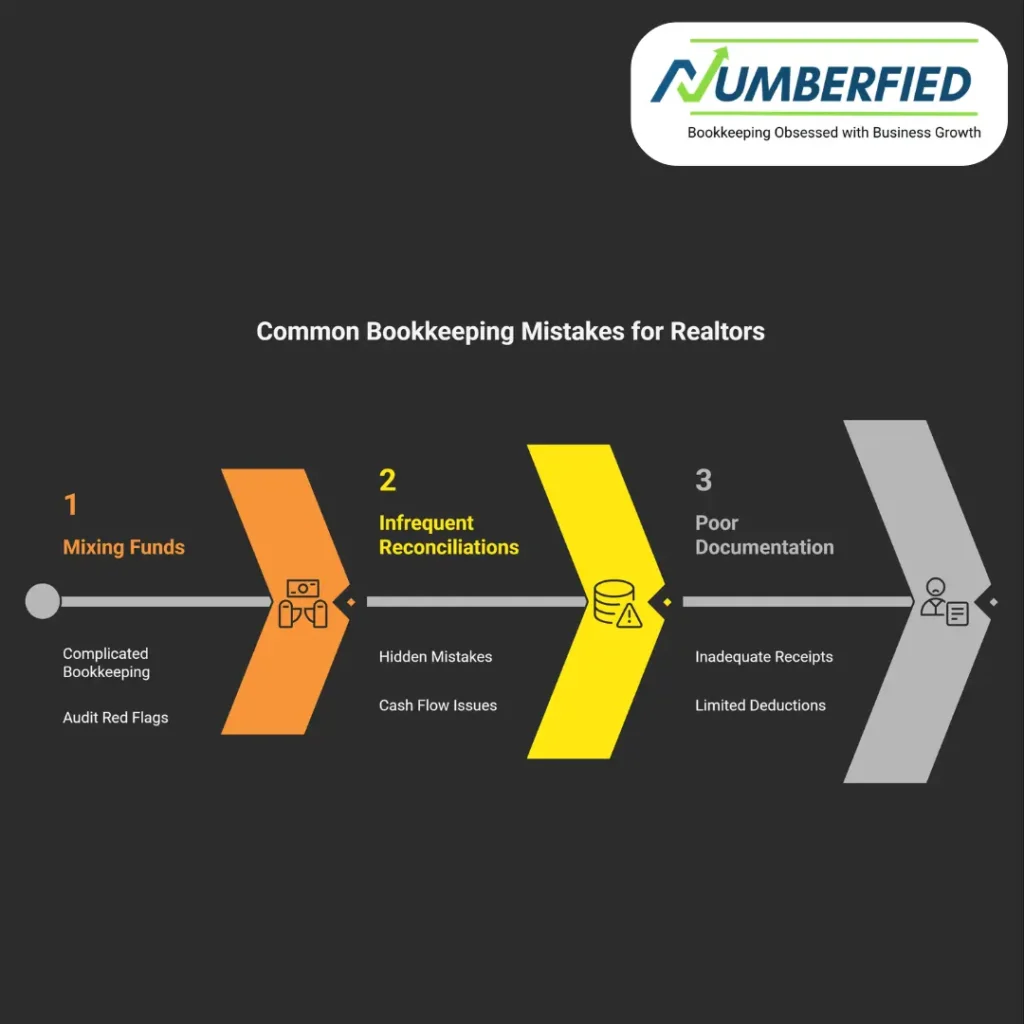
Common Mistakes and How to Avoid Them
Mistake: Mixing personal and business funds
Mixing accounts complicates bookkeeping for realtors and raises red flags for audits. Maintain separate business bank accounts and cards to delineate transactions clearly.
Mistake: Infrequent reconciliations
Delaying reconciliations hides mistakes and cash flow issues. Regular reconciliations are an essential discipline in bookkeeping for realtors to maintain accuracy.
Mistake: Poor documentation
Inadequate receipts and incomplete records weaken bookkeeping for realtors and limit deductible expenses. Keep detailed records and attach documentation to transactions.
How Numberfied Supports Realtors
Specialized real estate bookkeeping services
Numberfied provides bookkeeping for realtors tailored to industry needs: commission tracking, trust accounting, vendor management, and owner distributions. Our team understands the nuances of real estate finances, so your books are reliable and audit-ready.
Customized workflows and integrations
We design workflows that integrate with your existing CRM, transaction platforms, and bank accounts. Seamless integrations make bookkeeping for realtors efficient and reduce duplicate work.
Advisory and tax-ready reporting
Beyond transaction processing, Numberfied prepares actionable reports, supports tax preparation, and provides advisory insights to improve profitability. Accurate bookkeeping for realtors is the foundation for smarter strategic decisions.
Pricing, Onboarding, and Next Steps
Transparent pricing models
Numberfied offers scalable pricing based on transaction volume and service level. Transparent packages make it easy to understand the cost of professional bookkeeping for realtors and choose the right growth plan.
Simple onboarding process
The onboarding process includes data intake, system integrations, chart of accounts setup, and an onboarding checklist designed to get bookkeeping for realtors running smoothly within weeks.
Ongoing communication and reviews
We provide regular financial reviews and a dedicated point of contact, so bookkeeping for realtors remains aligned with your business goals. Quarterly performance sessions help plan for taxes, hiring, and expansion.
Case Study: From Chaos to Clarity
Initial challenges
A mid-sized brokerage faced late payments, unclear commission splits, and time-consuming manual reconciliations. They needed scalable bookkeeping for realtors to stabilize finances and support growth.
Implementation steps
Numberfied implemented a cloud accounting system, standardized the chart of accounts, automated bank feeds, and set up trust accounting procedures. These steps formed the backbone of better bookkeeping for realtors.
Results and benefits
Within three months, the brokerage had timely reports, accurate commission calculations, and cleaner tax-prep documents. The improved bookkeeping for realtors allowed leadership to focus on client acquisition and agent performance.
Conclusion
Good bookkeeping for realtors is more than compliance; it is a strategic asset that clarifies performance, improves cash flow, and supports growth. If you want reliable, tax-ready books and actionable financial insights, visit Numberfied at https://numberfied.com/ to learn how our bookkeeping for realtors services can transform your practice. Contact our team for a consultation and start building stronger financial systems today.
Frequently Asked Questions
What is bookkeeping for realtors?
Bookkeeping for realtors is the organized recording of all financial transactions related to real estate activities, including commissions, marketing expenses, escrow funds, and overhead.
How often should realtors update their books?
Ideally, daily for transactions and at a minimum, weekly reconciliations. Regular attention keeps realtors bookkeeping accurate and prevents end-of-month backlogs.
Can I do bookkeeping for realtors myself?
Yes, many solo agents manage basic bookkeeping, but as volume grows or trust accounting is required, professional services improve accuracy and compliance.
What software is best for realtors bookkeeping?
Cloud-based accounting platforms that integrate with CRMs and transaction systems are preferred. The best choice depends on your team size and specific integration needs.
How does bookkeeping for realtors handle escrow or trust funds?
Trust funds should be kept in separate bank accounts with detailed ledgers and reconciliations to show that client funds are segregated from operating accounts.
What records do realtors need for taxes?
Keep commission statements, W-9s/1099s, receipts for deductible expenses, mileage logs, and bank statements to support filings when bookkeeping for realtors is prepared for tax season.
How much does outsourcing bookkeeping for realtors cost?
Costs vary by transaction volume and services. Numberfied offers scalable pricing and transparent plans so you can match service levels to your needs.
How long does onboarding take?
Onboarding typically takes a few weeks, depending on data complexity. Numberfied follows a structured process to quickly move a realtor’s bookkeeping to a steady state.
Will outsourcing bookkeeping for realtors help with taxes?
Yes. Accurate bookkeeping provides tax-ready reports and documentation that reduce preparation time and enable confident identification of deductible expenses.
How does Numberfied protect my financial data?
Numberfied uses secure, encrypted systems, role-based access controls, and regular backups to safeguard sensitive financial information involved in bookkeeping for realtors.
Read Also: Why Numberfied’s Bookkeeping Accounting Service Is Your Small Business’s Secret Weapon