
Introduction
Bookkeeping services outsourcing is a strategic choice for small businesses and medium-sized companies that want accurate financial information, timely financial reporting, and the freedom to focus on core business activities. By choosing outsourced bookkeeping and accounting services, you can access highly skilled accounting professionals, modern accounting software, and real-time financial insights without the overhead of growing an in-house accounting team. This article explains the benefits, comparisons, selection steps, common challenges, and trends so you can outsource your bookkeeping with confidence.
Key benefits of bookkeeping services outsourcing
Cost savings and predictable pricing
Outsourcing your bookkeeping reduces overhead like salaries, benefits, office space, and training for an in-house bookkeeper or accounting department. Outsourced accounting services typically offer flexible pricing, monthly bookkeeping packages, per-transaction fees, or bundled services including payroll and tax preparation, so you only pay for the services to meet your accounting needs. This predictable expense model helps small businesses plan cash flow and invest more in growth.
Improved accuracy and compliance
Outsourced bookkeeping firms employ experienced bookkeepers and accountants who specialize in bookkeeping tasks, financial statements, and financial reporting. With standardized bookkeeping processes and the latest bookkeeping software, these providers reduce errors and ensure accurate financial records. Accurate financial information supports timely tax preparation, compliance, and professional advisory services.
Scalability and flexibility
As your business grows, bookkeeping outsourcing scales with you. Whether you need basic bookkeeping services, monthly bookkeeping, controller services, or complex accounting and advisory services, an outsourced provider can expand services quickly. Remote bookkeeping and virtual bookkeeping services make it easy to add capacity without hiring more staff, giving your business agility when revenues fluctuate.
Access to modern tools and expertise
Outsourced bookkeeping companies invest in leading accounting software, QuickBooks, cloud-based bookkeeping software, and integrated payroll and reporting tools so your business benefits from real-time financial dashboards and automated workflows. You also gain access to specialists such as controllers, accountants, and CFO services who provide meaningful financial insights and support business decisions.
Focus on core business activities
By outsourcing bookkeeping work, leadership and internal teams regain time to focus on sales, product development, customer service, and strategic growth. Outsourced accounting frees up internal resources and provides peace of mind that financial management is being handled professionally.
In-house vs. outsourcing comparison
Choosing between an in-house bookkeeper and an outsourced accounting and bookkeeping solution depends on business needs, complexity, and budget. Below is a practical comparison to help decide.
When in-house makes sense
- Simple, low-volume bookkeeping with predictable processes
- Need for immediate, on-site collaboration with operations
- Desire to keep sensitive data physical or local
When is outsourcing better
- Desire cost savings and predictable monthly costs
- Need access to a range of expertise (tax preparation, payroll, controller services)
- Require scalable support during periods of growth or seasonality
- Desire modern accounting software and real-time financial reporting without capital investment
Hybrid model
Many firms adopt a hybrid approach: retain a small in-house bookkeeper for daily operational tasks and outsource more complex bookkeeping tasks, month-end close, tax prep, and advisory services to an accounting firm. This model combines the benefits of local presence with the efficiency and expertise of outsourced accounting.
Essential features to look for in a provider
Not all bookkeeping service providers are equal. When you evaluate outsourced bookkeeping services, prioritize these features:
1. Cloud-based accounting software and integrations
Ensure the provider uses secure, widely adopted accounting software (QuickBooks Online, Xero, or similar) with integrations to your payroll, POS, and banking systems to create a centralized bookkeeping environment and provide real-time financial data.
2. Clear service scope and deliverables
Request a detailed list of services to be performed: bookkeeping tasks, reconciliations, monthly bookkeeping, financial statements, payroll processing, tax preparation assistance, and advisory services. Clear deliverables prevent scope creep and unexpected charges.
3. Security and compliance
Confirm the firm follows best practices for data security, including encrypted data transfer, multi-factor authentication, secure backups, and compliance with relevant regulations for financial information.
4. Experienced staff and accountant oversight
Look for bookkeeping and accounting teams that include certified professionals, accountants, or controller-level oversight to ensure accuracy and advanced financial reporting capabilities.
5. Communication and responsiveness
Evaluate how the bookkeeping firm communicates: regular month-end meetings, frequency of reporting, access to dashboards, and availability for questions. Prompt, clear communication is essential for effective outsourced accounting.
6. Industry experience and advisory capability
Providers with experience in your industry can better handle unique accounting requirements and provide actionable financial insights, including advisory services and CFO support as your business grows.
Common challenges and mistakes to avoid
Outsourcing bookkeeping offers many benefits, but businesses often encounter pitfalls. Being aware of common mistakes helps you avoid them.
Poorly defined scope
Not clarifying which bookkeeping functions are included, such asd bank reconciliations, accounts payable/receivable, payroll, or tax prep, leads to confusion. Define services, frequency, and performance metrics in writing.
Choosing solely on price
Low-cost providers may cut corners on accuracy, security, or expertise. Balance cost with demonstrated experience, references, and technology. Consider the total value, including reduced errors and better financial insights.
Failing to standardize bookkeeping processes
Without consistent bookkeeping processes, outsourced teams will struggle to deliver accurate, timely financial statements. Work with your provider to implement clear procedures and use accounting software workflows.
Not providing proper access and documentation
Delayed access to bank feeds, invoices, receipts, and payroll data hampers accuracy and timeliness. Prepare a checklist of documents and grant secure access to necessary systems during onboarding.
Ignoring change management
Transitioning bookkeeping functions requires internal buy-in. Communicate benefits and new responsibilities clearly to your staff, and provide training if the provider introduces new software or processes.
Step-by-step guide to selecting and implementing bookkeeping services outsourcing
Step 1: Assess your accounting needs
List your current bookkeeping tasks: daily transaction entry, reconciliations, monthly close, payroll, tax preparation, and reporting. Identify pain points, errors, delays, or lack of insights, and determine whether you need basic bookkeeping services or full outsourced accounting and advisory services.
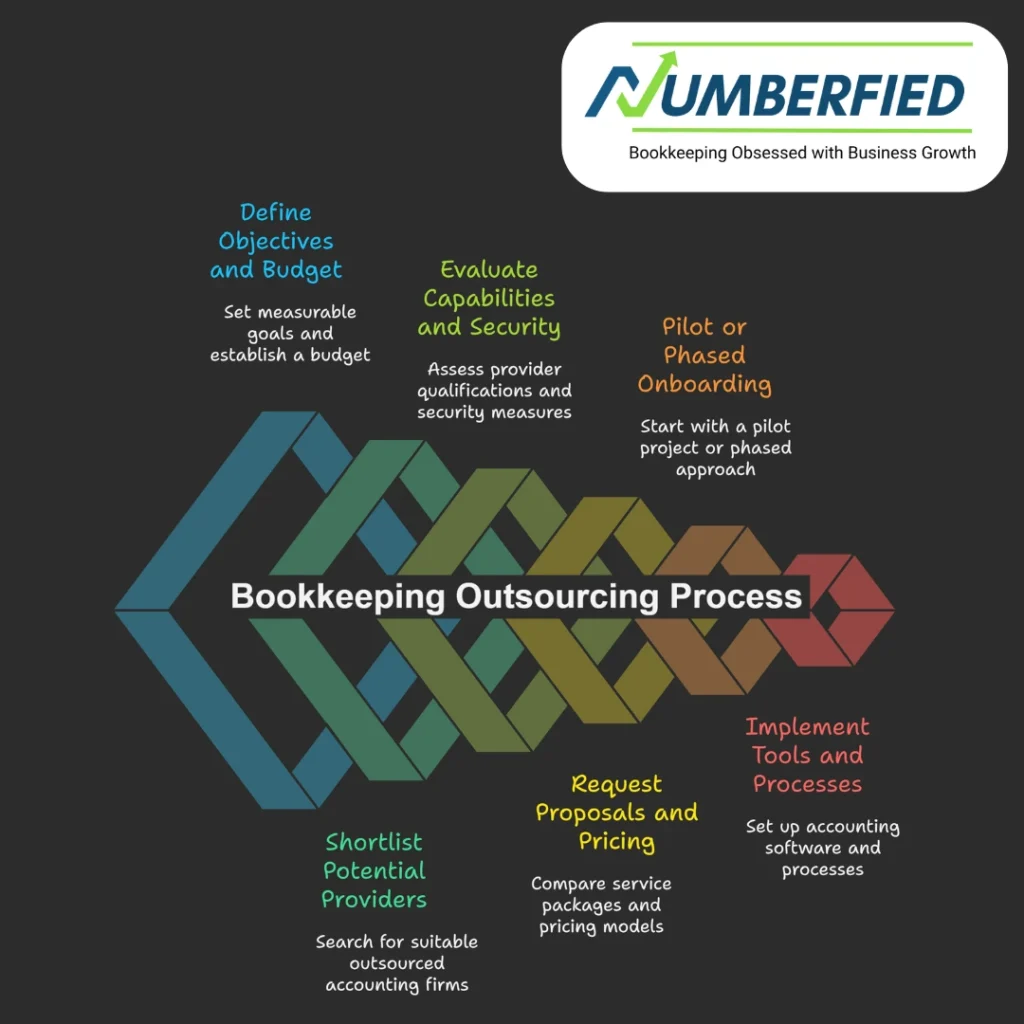
Step 2: Define objectives and budget
Set measurable goals: reduce accounting costs by a percentage, shorten the month-end close to X days, or receive real-time financial reports. Establish a budget that reflects the level of service required and the value of accurate financial information.
Step 3: Shortlist potential providers
Search for outsourced accounting firms, virtual bookkeeping providers, or bookkeeping firms with small business expertise. Look for reviews, case studies, and offerings like outsourced bookkeeping, controller services, and CFO services. Consider local bookkeeper options if in-person work is necessary, but prioritize providers that offer secure online bookkeeping service capabilities.
Step 4: Evaluate capabilities and security
Request service descriptions, technology stacks (QuickBooks, integrations), staff qualifications, sample financial statements, and security policies. Ask about backup procedures, data ownership, and compliance measures.
Step 5: Request proposals and pricing models
Ask for detailed proposals that include scope, deliverables, timelines, transition plans, and pricing. Compare monthly bookkeeping service packages versus bespoke pricing for outsourced accounting and bookkeeping functions.
Step 6: Pilot or phased onboarding
Start with a pilot project or phased approach, outsource monthly bookkeeping and reconciliations first, then expand to payroll or advisory services. A phased onboarding reduces risk and allows your team to adjust.
Step 7: Implement tools and processes
Work with the provider to set up accounting software, connect bank feeds, configure payroll and tax systems, and document bookkeeping processes. Ensure access control and training for staff who will interact with the bookkeeping team.
Step 8: Monitor and iterate
Establish KPIs: accuracy rate, month-end close time, timeliness of financial statements, and responsiveness. Hold regular reviews to refine processes, expand services, and ensure bookkeeping functions align with business needs.
Top providers and current trends
Types of providers
There are several models of bookkeeping outsourcing providers:
- Virtual bookkeeping and online bookkeeping services that serve small businesses remotely
- Full-service outsourced accounting firms offering bookkeeping, payroll, tax preparation, and CFO advisory services
- Specialized bookkeeping firms focused on industry-specific accounting processes
- Offshore bookkeeping companies that provide cost-effective bookkeeping services with skilled teams abroad
Checklist before you outsource bookkeeping
- Document current bookkeeping processes and data sources
- Decide which tasks to keep in-house and which to outsource
- Choose compatible accounting software (QuickBooks or equivalent) and confirm integrations
- Prepare a list of required deliverables: financial statements, payroll, tax prep, reconciliations
- Securely share access and establish data security expectations
- Set KPIs and communication cadence
- Plan a phased transition and contingency for the initial months
How outsourced bookkeeping supports growth and financial health
Outsourced bookkeeping and accounting support business growth by delivering accurate financial statements, timely financial reporting, and strategic advice. When bookkeeping processes are reliable, you can identify profitable products, control costs, and plan investments. Regular financial reporting gives your management team and external stakeholders confidence in your financial management. Whether you need bookkeeping and tax preparation, payroll integration, or full outsourced accounting services, the right bookkeeping firm becomes an extension of your accounting function and helps you manage financial operations as your business grows.
Conclusion
If your business struggles with bookkeeping accuracy, month-end delays, or lacks financial insights to make decisions, bookkeeping services outsourcing can be a practical solution. Start by assessing your accounting needs, setting measurable goals, and evaluating providers against security, technology, and expertise criteria. Use a phased onboarding approach and monitor KPIs to ensure the outsourced accounting team delivers reliable, accurate financial information.
Outsourcing bookkeeping services is not just a cost-saving move; it’s an investment in better financial management, compliance, and the ability to focus on what you do best: grow your business.
Ready to outsource bookkeeping and regain time to focus on core business activities? Request a free consultation with our bookkeeping and accounting experts to assess your accounting needs, evaluate the right outsourced accounting services for your business, and get a tailored plan that includes bookkeeping processes, accounting software setup, and ongoing financial reporting. Contact us today to start with a complimentary review of your current financial records and a roadmap to accurate, real-time financial management.
FAQ
What are outsourced bookkeeping services?
Outsourced bookkeeping services involve hiring an external provider (often a specialist firm or virtual team) to manage your business’s financial records, including transaction entry, bank reconciliations, accounts payable/receivable, payroll processing, and financial reporting, usually remotely via cloud software.
How do you outsource your bookkeeping?
To outsource bookkeeping, identify your needs, research reputable providers (local or offshore), request quotes, share secure access to your accounting software (e.g., Xero, QuickBooks), and let their team handle daily tasks while you review reports and approve key decisions.
What are the four types of outsourcing?
The four main types of outsourcing are offshore (to distant countries like India or the Philippines for cost savings), nearshore (to nearby countries with similar time zones), onshore (within Australia for easier communication and compliance), and business process outsourcing (specific functions like bookkeeping or payroll).
What is an example of outsourcing?
An example of outsourcing is a small business in Sydney hiring a virtual bookkeeping team in Manila to handle daily transaction recording, bank reconciliations, and BAS preparation using Xero, instead of employing a full-time bookkeeper in-house.
What do bookkeepers charge per hour in Australia?
In Australia, bookkeepers typically charge $45–$90 per hour in 2026. Freelancers or junior bookkeepers often fall in the $45–$65 range, while experienced or certified bookkeepers (e.g., with BAS agent registration) usually charge $70–$90+ per hour.
How much does it cost to outsource bookkeeping?
Outsourcing bookkeeping in Australia typically costs $300–$1,800 per month for small to medium businesses, depending on transaction volume, complexity, and services (e.g, BAS, payroll). Basic packages often start around $400–$800 monthly.
How much does it cost to outsource bookkeeping?
Monthly costs for outsourced bookkeeping services in Australia generally range from $400 to $1,500 for most small businesses. Higher volumes, payroll, or advisory services can push fees toward $1,800+ per month.
What are outsourcing bookkeeping services?
Outsourcing bookkeeping services means delegating your financial record-keeping tasks (transaction entry, reconciliations, reporting, and AS lodgement) to an external professional or team, usually via secure cloud platforms, instead of handling them in-house.
Is it a good idea to outsource bookkeeping?
Yes, outsourcing bookkeeping is often a smart decision for small to medium businesses in Australia. It saves time and money, provides expert accuracy and compliance (especially with ATO rules), reduces errors, and lets owners focus on growth rather than admin.
What do bookkeepers charge per hour in Australia?
Australian bookkeepers typically charge between $45 and $90 per hour in 2026. Rates vary by experience, location, and certification. Junior or freelance bookkeepers often sit at $45–$65, while qualified BAS agents or senior professionals charge $70–$90 or more.
Read Also: Virtual Bookkeeping Services for Small Businesses That’ll Change Your Life!