
Introduction
As the Numberfied team, we’re excited to share a practical, actionable guide to offshore bookkeeping to help U.S. businesses make confident, informed decisions about managing their accounting remotely. In today’s fast-moving business environment, companies are increasingly turning to offshore bookkeeping to reduce costs, improve efficiency, and access skilled global talent. Still, success isn’t just about outsourcing; it’s about doing it right.
In this guide, we cover everything you need to know, including key benefits, essential U.S. compliance considerations, proven processes for smooth collaboration, and how to partner with a trusted provider to scale your financial operations effectively. Whether you’re a startup aiming to streamline expenses or a growing business looking to optimize back-office functions, this guide will provide the clarity and direction you need to move forward strategically.
Key Takeaways
- Offshore bookkeeping can offer cost efficiency, access to skilled staff, and operational flexibility when managed correctly.
- Compliance, robust security, and clear communication are essential to realizing the benefits of offshore bookkeeping.
- Structured onboarding, documented workflows, and regular reporting make offshore bookkeeping productive and transparent.
Why Consider Offshore Bookkeeping?
Understanding the strategic value
Businesses seek predictable financial operations and specialized talent pools. Offshore bookkeeping can provide steady support for routine accounting tasks while freeing internal teams for strategic work.
Common business drivers
Companies often pursue offshore bookkeeping to standardize processes, improve responsiveness, and access a broader talent pool. These drivers align with growth, cost management, and operational resilience goals.
Balancing cost and quality
Cost advantages are real but must be balanced with quality metrics. Evaluate providers on accuracy, turnaround times, and technology integration rather than price alone.
How Offshore Bookkeeping Works
Typical service models
Service models range from dedicated teams to shared resources. Dedicated teams work like remote extensions of your accounting department, while shared models offer flexible capacity.
Workflow integration
Effective offshore bookkeeping depends on integrated workflows, clear task owners, and automated routines for reconciliations, payroll input, and invoicing.
Technology and tools
Cloud accounting platforms, secure file exchange, and communication tools are central. Integration reduces manual entry and improves visibility across finance operations.
Choosing the Right Offshore Bookkeeping Partner
Evaluate expertise and certifications
Select partners with proven accounting knowledge, relevant certifications, and experience serving U.S. companies. Expertise matters in understanding U.S. reporting needs and tax-related considerations.
Security and data protection
Ask about encryption, access controls, and compliance frameworks. Strong cybersecurity practices are nonnegotiable for offshore bookkeeping relationships to protect sensitive financial data.
Communication and reporting standards
Define reporting cadence, escalation paths, and performance metrics before engagement. Clear expectations avoid surprises and keep accounting aligned with business rhythms.
Implementation: From Pilot to Full Scale
Design a pilot program
Start with a pilot focusing on a narrow set of accounting activities. A well-scoped pilot reduces risk and provides measurable results to guide scaling.
Onboarding and knowledge transfer
Document processes, provide system access, and run joint training sessions. Effective knowledge transfer accelerates productivity and builds trust between teams.
Continuous improvement cycles
Set up regular reviews, conduct root-cause analysis of errors, and implement optimization initiatives. Continuous improvement keeps offshore bookkeeping aligned with evolving business needs.
Managing Risk and Ensuring Compliance
Regulatory considerations for U.S. businesses
Understand cross-border data transfer rules and local labor laws that may affect operations. Compliance ensures that offshore bookkeeping supports rather than complicates regulatory obligations.
Internal controls and segregation of duties
Maintain controls that prevent conflicts of interest and fraud. Segregate duties across functions and require independent checks to uphold financial integrity.
Audit readiness and documentation
Keep clear documentation of procedures, approvals, and reconciliations. Being audit-ready reduces stress during reviews and supports transparent financial reporting.
Cost, ROI, and Performance Metrics
Measuring value beyond cost savings
Quantify time saved, error reduction, and improved reporting cycle times. ROI for offshore bookkeeping often comes from improved capacity and predictable delivery.
Key performance indicators
Track KPIs like ledger close time, reconciliation accuracy, and invoice processing time. These metrics indicate whether the offshore relationship is meeting expectations.
Adjusting scope for maximum impact
Shift responsibilities as confidence grows. Start with transactional work and move to higher-value tasks when controls and performance stabilize.
Best Practices for Successful Offshore Bookkeeping
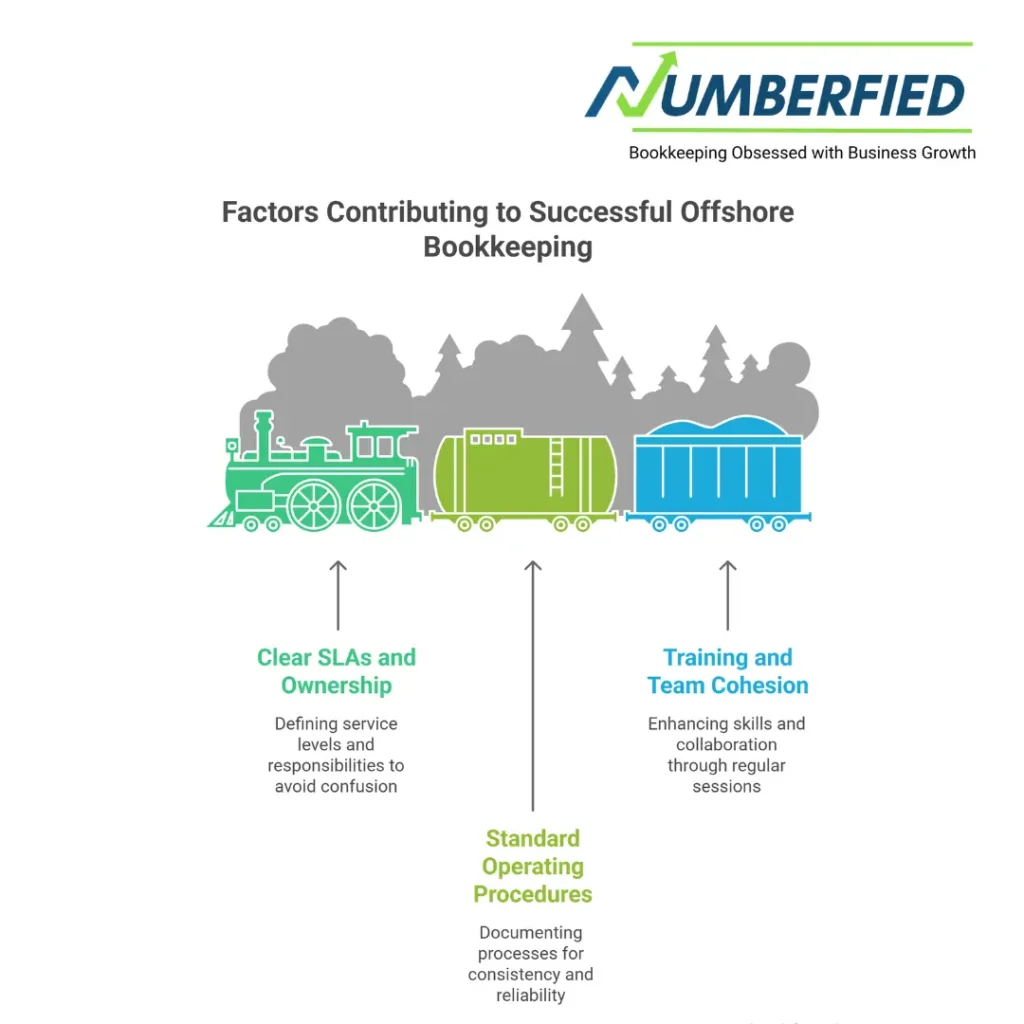
Set clear SLAs and ownership
Service-level agreements and defined owners prevent ambiguity. Clear service expectations help teams maintain consistent outcomes.
Adopt standard operating procedures
Standard operating procedures document how tasks are completed, approved, and escalated. SOPs are the backbone of reliable offshore bookkeeping operations.
Invest in training and team cohesion
Regular training sessions and joint retrospectives create alignment. Cultural awareness and shared goals improve collaboration and reduce friction.
Technology Stack Recommendations
Cloud accounting platforms
Choose platforms that support multi-user access, audit trails, and integrations with banking and payroll. Cloud-native solutions simplify collaboration for offshore bookkeeping teams.
Automation and AI tools
Automation for invoice capture, reconciliations, and coding reduces manual errors. Evaluate tools that work with your systems and enhance throughput.
Secure communication channels
Use encrypted file transfer and role-based access. Secure communication preserves confidentiality and supports compliance for offshore bookkeeping activities.
Scaling Finance Operations with Offshore Bookkeeping
When to scale
Scale when transaction volumes grow, or the internal team is constrained. Offshore bookkeeping provides flexible bandwidth to support seasonal peaks and growth phases.
Transition planning
Create a phased transition plan with milestones, testing phases, and fallback arrangements. Phased transitions reduce operational risk during scale-up.
Maintaining quality at scale
Implement quality assurance, periodic audits, and performance reviews. Quality management preserves accuracy as teams and volumes expand.
Case Studies and Practical Examples
Streamlining monthly close
One approach is to delegate reconciliations and journal entries to offshore teams under strict checklists. This reduces close time and frees senior staff for analysis.
Improving invoice processing
Offshore bookkeeping teams can manage invoice capture, vendor matching, and exception handling, improving supplier relationships and payment accuracy.
Supporting strategic projects
As processes stabilize, offshore bookkeeping teams can support budgeting, generate ad hoc reports, and assist with system migrations to accelerate strategic initiatives.
Practical Onboarding Checklist
Access and permissions
Grant necessary system access with least-privilege principles. Regularly review permissions to maintain security during onboarding and beyond.
Documented processes
Provide process maps, example files, and decision rules. Good documentation reduces iteration and accelerates accuracy for offshore bookkeeping tasks.
Initial quality review
Perform a reconciliation and sampling review after the first cycle. Early quality reviews catch gaps and set expectations for performance.
Conclusion
Offshore bookkeeping can be a strategic asset for U.S. businesses seeking scalability, skilled support, and predictable finance operations. By prioritizing security, compliance, clear communication, and measurable performance, you can unlock the benefits while mitigating risks. If you are ready to explore a tailored offshore bookkeeping solution that aligns with your business goals, visit our site and get in touch for a consultation: https://numberfied.com/
Frequently Asked Questions
What is offshore bookkeeping, and how does it differ from onshore services?
Offshore bookkeeping refers to delegating accounting tasks to teams located outside the company’s country, often in regions with lower labor costs or specialized talent pools. The core accounting work remains the same, but offshore bookkeeping introduces considerations around time zones, communication, and cross-border compliance that require structured management.
Is offshore bookkeeping secure for U.S. companies?
Security depends on provider controls, technology, and contractual safeguards. Reputable providers implement encryption, access controls, and compliance frameworks. When selecting an offshore bookkeeping partner, verify certifications and conduct due diligence to confirm robust security practices.
How do I maintain compliance when using offshore bookkeeping providers?
Maintain compliance by documenting processes, retaining records in compliant systems, and clarifying roles for tax and regulatory obligations. A good provider will support compliance requirements and help prepare documentation for audits, ensuring offshore bookkeeping aligns with U.S. regulations.
What tasks are commonly outsourced to offshore bookkeeping teams?
Common tasks include accounts payable and receivable processing, bank reconciliations, general ledger maintenance, and payroll support. As trust builds, offshore bookkeeping teams can take on more advanced tasks, such as month-end close and management reporting.
How do I measure the performance of an offshore bookkeeping engagement?
Define KPIs such as close cycle time, error rates, and invoice processing time. Regular performance reviews, service-level agreements, and exception tracking help measure whether offshore bookkeeping meets expectations and delivers intended value.
What are the best communication practices with offshore bookkeeping teams?
Set regular meetings, use shared dashboards, and define communication protocols for exceptions and escalations. Clear documentation of workflows and priorities reduces confusion and keeps offshore bookkeeping aligned with business needs.
Can offshore bookkeeping support industry-specific accounting needs?
Yes, many offshore providers develop vertical expertise in industries like technology, services, and retail. Ensure the partner you choose has relevant experience and can adopt your chart of accounts, revenue recognition policies, and industry-specific reporting for offshore bookkeeping tasks.
How do I start a pilot for offshore bookkeeping?
Identify a narrow scope, set success criteria, and establish data access and documentation. Run the pilot for a defined period, measure results, and iterate based on lessons learned. A disciplined pilot reduces risk and demonstrates offshore bookkeeping value.
What technologies improve offshore bookkeeping outcomes?
Cloud accounting platforms, automated invoice capture, and secure file sharing improve speed and accuracy. Integration between systems reduces manual work and provides visibility, helping offshore bookkeeping teams deliver consistent results.
How do I decide whether to scale offshore bookkeeping for my entire finance function?
Base the decision on pilot results, KPI trends, and confidence in controls. If accuracy, timeliness, and communication meet expectations, a phased scale-up preserves quality. Use governance, training, and audits to maintain standards as offshore bookkeeping responsibilities expand.
Read Also: How Bookkeeping & Accounting Services Can Transform Your Business Growth