

Introduction
As a small to medium business owner, startup founder, entrepreneur, sole proprietor, freelancer, or self-employed professional, every dollar spent on support services needs to deliver clear value. Outsourced accounting services pricing is one of the most important factors when deciding whether to hand off your books, payroll, tax prep, and financial reporting to a remote team. Done right, outsourcing can cut your accounting costs by 40–70% compared to in-house staffing while delivering better accuracy, compliance, and insights, but pricing varies widely based on your business size, type, and needs.
In 2026, with inflation stabilizing at 2–3% annually, outsourced accounting service rates have adjusted upward from 2024 levels, but AI-driven efficiency has kept increases modest (5–8% year-over-year). Average monthly fees now range from $500 for basic sole proprietor support to $3,500+ for mid-market businesses with payroll and multi-state tax needs.
This guide breaks down realistic pricing ranges, factors driving differences, hidden vs. transparent structures, value vs. cost analysis with ROI calculations, benchmarks from leading providers, negotiation levers, and future pricing evolution so you can make an informed choice that fits your budget and delivers measurable returns. We’ll also include an in-house/DIY pricing comparison, essential transparency questions, common traps/red flags, and a step-by-step evaluation/negotiation guide to help you secure the best deal.
Realistic 2026 Pricing Ranges for Outsourced Accounting Services
Outsourced accounting services pricing in 2026 has evolved to include more flexible models, reflecting market maturation and AI efficiencies. Here’s a breakdown of common structures with estimates adjusted for 3% annual inflation from 2024 benchmarks.
Monthly Fixed-Fee Tiers
The most popular model for predictability pays a set monthly rate for a defined scope. In 2026:
- Entry-level (basic bookkeeping for sole proprietors/freelancers with <100 monthly transactions, no payroll): $500–$800/month. Ideal for simple service-based businesses, such as consulting or writing.
- Mid-tier (bookkeeping + basic compliance for service-based SMBs with payroll for 1–5 employees): $1,200–$2,200/month. Suit professional services firms or local retailers.
- Premium (full-service for e-commerce/inventory-based businesses or startups with 5–20 employees, multi-state tax, and basic advisory): $2,500–$3,500+/month. Perfect for online stores with Shopify/Amazon integration or capital-raising startups needing investor-ready reports.
Per-Transaction Models
For variable-volume businesses like e-commerce or freelancers. Pricing: $0.50–$1.50 per transaction (import/categorization/reconciliation) + $200–$500 base fee. In 2026, expect $600–$1,800/month for 500–1,000 transactions; it scales well for seasonal businesses but can surprise during peaks.
Hybrid Hourly/Fixed Models
Fixed base fee for core bookkeeping ($400–$1,200/month) + hourly add-ons ($40–$80/hour) for extras like payroll runs or tax prep coordination. Popular for growing startups: base keeps costs low, hourly covers surges.
Value-Based Pricing
Emerging in 2026: fees tied to outcomes like tax savings achieved, compliance risk reduced, or advisory value delivered (e.g., 10–20% of verified deductions). Ranges from $1,000–$4,000/month for mid-tier, appealing for businesses where ROI is easy to measure.
Breakdowns by business type (2026 estimates):
- Freelancers/sole proprietors (low volume, no inventory/payroll): $500–$1,000/month fixed-fee.
- E-commerce with inventory (high transactions, multi-state tax): $1,500–$3,000/month hybrid or per-transaction.
- Service-based SMBs with payroll: $1,200–$2,500/month mid-tier fixed.
- Startups raising capital (investor reporting, forecasting): $2,000–$3,500+ premium with value-based elements.
Factors That Drive Outsourced Accounting Services Pricing Differences
Outsourced accounting pricing isn’t one-size-fits-all; several variables influence your quote.
Transaction Volume
More transactions mean more work: low-volume (<100/month) starts at $500; high-volume (500–1,000+) reaches $2,000–$3,000. E-commerce sellers with daily imports pay more due to reconciliation complexity.
Complexity of Books
Simple service-based (consulting, freelance) is cheaper; complex setups (inventory COGS, multi-currency, job costing for contractors, subscription billing for SaaS) add 20–50% to costs. Multi-state sales tax or payroll for 10+ employees pushes pricing to mid/premium tiers.
Industry-Specific Needs
Industries like e-commerce (Shopify/Amazon reconciliation), real estate (property depreciation), or healthcare (HIPAA compliance) require specialized knowledge, increasing rates by 15–30%. Providers with vertical expertise charge a premium but deliver more value.
Add-On Services
Base pricing covers bookkeeping; add-ons like CFO-level advisory ($500–$1,500/month extra), fractional controller support, or advanced forecasting raise totals. Startups often bundle for capital-raising prep.
Geographic Cost-of-Service Variations
US-based providers charge 20–50% more ($1,500–$3,500/month mid-tier) than offshore (India/Philippines, $800–$2,000), but offer same-time-zone communication and deeper IRS knowledge. Hybrid models (US oversight + offshore execution) balance cost and quality at $1,200–$2,500.
Technology Stack Used by the Provider
Providers with AI automation, custom integrations, and real-time dashboards charge more but reduce errors and time. Basic manual providers are cheaper but riskier.
Hidden vs. Transparent Outsourced Accounting Services Pricing
Many quotes look attractive until hidden fees appear. Transparent providers disclose everything upfront; opaque ones bury costs in fine print.
Common Hidden Fees
- Setup/onboarding: $500–$2,000 one-time for data migration and configuration, essential but often not included in monthly quotes.
- Revision fees: $50–$150/hour for client-caused changes (e.g., late receipts).
- Surge/seasonal: 20–50% premium during tax season or high-volume periods.
- Exit/transition: $500–$1,500 to export data if you leave.
- Software pass-throughs: $20–$50/month for QuickBooks Online/Xero subscriptions if not included.
How to Spot True Total Cost of Ownership
Ask for an all-in 12-month projection including setup, monthly fees, add-ons, and any extras. Calculate the per-hour effective rate (total cost / estimated hours) and compare it to your internal time value. Transparent outsourced accounting service rates break this down clearly; red flags if they avoid specifics.
Value vs. Cost Analysis: Calculating ROI for Outsourced Accounting
Outsourced accounting services pricing isn’t just an expense; it’s an investment. Here’s how to calculate ROI.
- Tax savings: Better deduction capture and compliance often saves $2,000–$15,000/year (e.g., proper home office, mileage, health premiums).
- Penalty avoidance: Underpayment fines average $1,000–$5,000/year for many DIYers; outsourcing eliminates most.
- Time saved converted to billable hours: If you reclaim 15 hours/month at $100/hour value, that’s $18,000/year.
- Improved cash-flow management: Better A/R follow-up and forecasting reduces borrowing costs by 5–10% of annual expenses.
ROI formula: (Total savings + additional revenue from time freedom) / Annual outsourcing cost. Example: $12,000 cost yielding $25,000 in tax/penalty savings + $18,000 time value = 275% ROI. Most users see 150–400% returns within the first year.
Pricing Benchmarks from Leading Providers in 2026
Based on current trends, adjusted for 3% annual inflation and AI efficiencies compressing basic rates:
- Bench: Entry-level $249/month (basic bookkeeping), mid-market $499/month (with payroll/1099s), premium $749/month (advisory add-on).
- Pilot: Entry-level $599/month (basic), mid-market $999/month (full service), premium $1,999/month (CFO support).
- Bookkeeper360: Entry-level $399/month, mid-market $699/month, premium $1,299/month.
- inDinero: Mid-market $1,500/month, premium $2,500–$3,500/month (with fractional CFO).
- 1-800Accountant: Entry-level $129/month (basic tax), mid-market $499/month (full bookkeeping), premium $999/month (advisory).
Entry-level suits freelancers ($500–$800/month); mid-market for service SMBs ($1,200–$2,200); premium for e-commerce/startups ($2,500–$3,500+).
Negotiation Levers & Pricing Strategies
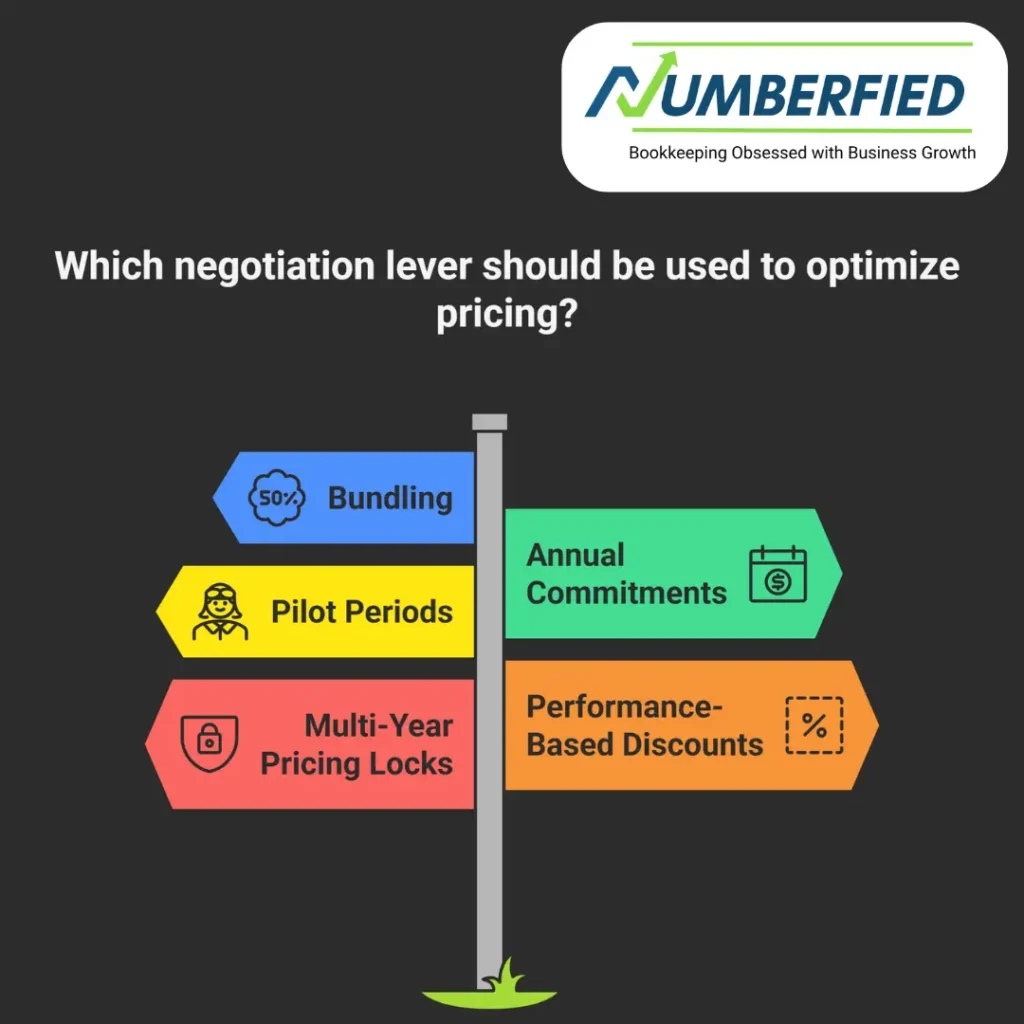
Don’t accept the first quote; use these to optimize.
Bundling vs. À la Carte
Bundle core services (bookkeeping + payroll + reporting) for 10–20% discounts. À la carte is flexible but costs more overall when negotiating add-on bundles.
Annual vs. Monthly Commitments
Annual prepay often saves 5–15% but locks you in. Monthly is flexible, but they ask for a hybrid (monthly with an annual discount after 6 months).
Pilot/Test Periods
Many offer 1–3 month discounted pilots (20–50% off). Use this to test fit and negotiate long-term rates based on performance.
Performance-Based Discounts
Tie 5–10% discounts to outcomes like zero compliance errors or $X in deduction savings. Common in value-based pricing models.
Multi-Year Pricing Locks
Lock rates for 2–3 years to hedge inflation, often with 3–5% annual caps. Negotiate exit clauses if needed.
Future Pricing Evolution in Outsourced Accounting Services Pricing for 2026–2027
AI is reshaping pricing for outsourced accounting services by automating 60–80% of routine tasks, compressing entry-level rates by 10–20% (e.g., basic bookkeeping falling to $400–$700/month). Value-based pricing shifts fees to outcomes, such as tax savings achieved or compliance audits passed, with mid-market packages priced at $1,500–$3,000. Micro-pricing emerges for fractional services (e.g., $200–$500/month for 10–20 hours), appealing to freelancers. Basic bookkeeping sees price compression as commoditized, while premium advisory-inclusive packages rise 5–8% due to demand. Overall, expect more transparent, outcome-focused pricing that rewards long-term partnerships.
In-House/DIY vs. Outsourced Pricing Comparison
In-house: $70,000–$120,000+ annual true cost (salary, taxes, benefits, software, training, management, error/penalty risk, opportunity cost of manager time). DIY: $200–$600/year software, but 10–25 hours/month your time ($10,000–$30,000+ opportunity cost at $100/hour) + high error/penalty risk ($1,000–$5,000/year average). Outsourced: $6,000–$30,000/year, with zero employment risk, expert fit, and often $5,000–$20,000+ in deduction/penalty savings. Essential transparency questions: “What’s your all-in first-year cost, including setup? Any revision/surge fees? What’s included in the base package? How do you calculate ROI for clients?”
Essential Pricing Transparency Questions to Ask Providers
- What’s the total first-year cost, including setup/onboarding, monthly fees, software pass-throughs, and any add-ons?
- Are there revision fees for client-provided corrections or surge charges during busy seasons?
- How do you handle exit/transition fees if we part ways?
- What’s the true cost per transaction/hour/client in your model?
- Can you provide a sample 12-month projection for a business like mine?
Common Pricing Traps & Red Flags in Outsourced Accounting Services Pricing
- Low teaser rates that spike after onboarding
- Vague “starting at” pricing without clear scopes
- Hidden software or app fees are passed through to you
- No caps on revision or surge hours
- Long lock-in contracts (12–24 months) without easy exit
Red flags: Providers avoiding detailed cost breakdowns, promising unrealistically low rates, or pushing upsells during the sales call instead of focusing on your needs.
Step-by-Step Guide to Evaluating & Negotiating Outsourced Accounting Services Pricing
Follow this process to secure the best value.
Step 1: Assess Your Needs & Baseline Cost
List transaction volume, services needed (bookkeeping only, full payroll, tax prep), business type, and current cost (in-house salary, DIY time value, penalties). This quantifies what “good pricing” looks like for you.
Step 2: Research Providers & Pricing Models
Search “outsourced accounting services pricing” or “outsourced accounting pricing for [business type].” Shortlist 4–6 providers with strong reviews, certifications, and fit for your industry.
Step 3: Request Detailed Proposals & Cost Projections
Ask for all-in 12-month breakdowns, including base fees, add-ons, setup, revisions, surges, exits, and software. Compare effective per-hour or per-transaction rates.
Step 4: Evaluate Transparency & Total Ownership Cost
Check for hidden fees and ask transparency questions. Calculate true TCO: annual fees + any one-time costs + estimated add-ons.
Step 5: Negotiate Using Levers
Use your research: “Provider X offers bundling at 10% off. Can you match?” Commit to an annual discount, ask for performance-based rebates, or bundle add-ons for free pilots.
Step 6: Run a Pilot & Test Value
Many offer discounted pilots of 1–3 months. Monitor ROI during pilot: time saved, deductions found, compliance errors avoided.
Step 7: Sign & Optimize Ongoing
Lock in negotiated terms in the contract. Schedule quarterly pricing reviews to adjust as your business evolves.
Conclusion
Outsourced accounting services pricing is about more than the monthly fee; it’s about finding a structure that delivers real value through cost savings, compliance, time freedom, and financial insights. By understanding ranges, factors, hidden costs, ROI, benchmarks, negotiation levers, and future evolution, you can secure a deal that fits your budget and supports growth. As AI efficiencies compress basic rates and value-based models gain traction in 2026–2027, now is the ideal time to explore. Ready to get the best value? Request a transparent pricing quote or free cost comparison today from a trusted provider and take the first step toward smarter, more affordable accounting.
FAQ
What is the typical outsourced accounting services pricing in 2026?
Outsourced accounting services pricing in 2026 ranges from $500 for entry-level basic bookkeeping to $3,500+ for premium full-service packages. Mid-tier options usually fall between $1,200–$2,200/month, depending on your business size and needs.
How do I calculate ROI for outsourced accounting services pricing?
Calculate ROI by subtracting the annual outsourced accounting services pricing from total value created: tax savings ($2,000–$15,000/year) + penalty avoidance ($1,000–$5,000) + time saved converted to billable hours ($10,000–$30,000 at $100/hour) + cash-flow improvements. Most users see 150–400% returns in year 1.
What services are usually included in outsourced accounting services pricing?
Outsourced accounting services pricing typically includes transaction processing & categorization, reconciliations, accounts payable/receivable, payroll & 1099 support, monthly statements, sales tax, and basic tax prep coordination. Premium tiers add advisory or fractional CFO support.
How do outsourced accounting services’ pricing differ from in-house or DIY?
Outsourced accounting services pricing is usually 50–70% less than in-house ($6,000–$30,000/year vs. $70,000–$120,000+) and provides expert fit without employment risk. DIY is cheapest ($200–$600/year software) but adds error/penalty risk and time cost ($10,000–$30,000+ opportunity).
Is my data secure with outsourced accounting services pricing?
Yes, reputable providers include bank-level encryption, 2FA, SOC 2 compliance, and cyber-insurance in their outsourced accounting services pricing. Ask about data privacy during quotes to ensure protection.
What are the latest trends in outsourced accounting services pricing for 2026?
Outsourced accounting services pricing in 2026 is shifting to value-based models (tied to tax savings or outcomes), AI reducing basic rates by 10–20%, micro-pricing for fractional services ($200–$500/month), and seasonal/surge flexibility without premiums.
What are red flags in outsourced accounting services pricing?
Red flags include vague “starting at” outsourced accounting services pricing without scopes, hidden setup/revision fees, surge charges not disclosed, no all-in first-year projection, or pressure to sign without a cost breakdown.
How can I get started with outsourced accounting services pricing?
Start by assessing your needs and budget, researching providers with transparent outsourced accounting services pricing, requesting detailed proposals with 12-month projections, and negotiating using bundling or annual commitments. Many offer free consultations. Schedule one today.
How does outsourced accounting services pricing vary by business size/type?
Outsourced accounting services pricing for freelancers/sole proprietors starts at $500–$1,000/month; e-commerce with inventory averages $1,500–$3,000; service-based SMBs with payroll $1,200–$2,500; startups raising capital $2,000–$3,500+ for investor-ready reporting.
Read Also: 7 Insider Tips to Simplify Your Finances with QuickBooks Bookkeeping Services for Small Businesses