

Introduction
Outsourcing back-office finance while keeping your brand front and center has become a smart, scalable strategy for modern firms. White label accounting services enable CPA firms, bookkeeping practices, and finance teams to deliver high-quality accounting, tax preparation, payroll, and advisory solutions under their own brand without expanding internal headcount. By leveraging experienced external professionals and advanced accounting technologies, firms can improve efficiency, maintain compliance, and enhance client satisfaction while focusing on growth and advisory work. This guide provides a practical, US-focused overview of white label accounting, covering its key benefits, potential challenges, compliance considerations, provider selection criteria, essential tools, tax preparation support, onboarding best practices, and how to measure return on investment effectively.
Key Takeaways
- White label accounting services let firms expand offerings quickly without building full internal teams.
- Key benefits: cost savings, access to expertise, scalability, and ability to focus on core activities.
- Key challenges: data privacy, systems integration, and maintaining oversight.
- Compliance with IRS rules and GAAP is critical; choose providers with US-focused expertise.
- Tools such as QuickBooks and Xero are common; confirm integrations and security.
Why White Label Accounting Services Matter Now
Market context and demand
As US businesses face increasing complexity in tax rules and financial reporting, many firms look to scale client services without the overhead of hiring specialized staff. White label accounting services are a strategic option to meet that demand while preserving brand identity and client relationships.
Who benefits most
Accounting firms, financial advisors, payroll companies, and software vendors can all benefit when they add white label accounting services to their portfolio. Small and mid-sized businesses also gain access to professional accounting under a trusted brand.
Our approach to this guide
This guide focuses on actionable advice for implementing or partnering for white label accounting services in the United States, with a balanced view of benefits and risks and clear tips for provider selection and measuring ROI.
Benefits of White Label Accounting Services
Cost savings and predictable pricing
White label accounting services typically reduce fixed labor costs because providers allocate experienced staff across many clients. This modular cost structure converts hiring and training expenses into predictable service fees, improving margin control.
Access to specialized expertise
By partnering with established providers, firms gain experienced accountants, tax preparers, and finance professionals without having to recruit. This access is particularly valuable for complex areas like multi-state taxation or specialized industry accounting.
Scalability and faster time-to-market
White label accounting services enable rapid scaling of offerings. Providers handle capacity management and staffing, allowing your firm to onboard new clients quickly and respond to seasonal demand without costly delays.
Challenges and Risk Management
Data privacy and security
Entrusting financial data to a third party introduces privacy risks. Ensure the provider maintains strong encryption, SOC 2 or equivalent certifications, robust access controls, and clear data retention policies.
Systems integration and workflow alignment
Integration gaps between your tech stack and the provider’s systems create friction. Map workflows, confirm API or file-transfer options, and pilot data exchanges before a full rollout.
Oversight, quality control, and client communication
White label accounting services require governance frameworks to ensure quality. Define approval workflows, SLAs, and client-facing communication protocols to ensure service delivery aligns with our brand promise.
US Compliance: IRS, GAAP, and Regulatory Considerations
IRS rules and tax filing responsibilities
When using white label accounting services for tax preparation, clarify responsibilities for filings and signatures. The provider must be current with IRS e-file rules, identity verification requirements, and dost practices.
for documentation retention, GAAP, and financial reporting standards
White label accounting services must apply Generally Accepted Accounting Principles (GAAP) when preparing financial statements for US entities. Confirm the provider’s experience with accrual accounting, revenue recognition, and disclosure requirements relevant to your clients.
State-level regulations and multi-jurisdictional tax
Multi-state clients require providers familiar with state tax nexus, sales tax, and payroll tax variations. Verify state experience and capabilities to file in all relevant jurisdictions.
Selecting a White Label Accounting Services Provider
Evaluate industry and US-specific expertise
Shortlist providers with demonstrable experience in US accounting and taxation. Request case studies and references related to your industry and client size.
Assess technology, integrations, and security
Ask about supported accounting platforms (QuickBooks, Xero, NetSuite), API availability, encryption standards, and compliance certifications. Insist on a technical demo showing real integrations.
Define SLAs, reporting, and governance
Negotiate service-level agreements that cover turnaround times, error rates, escalation procedures, and periodic reporting. Include audit rights and protocols for handling discrepancies.
Tools and Tech Stack: QuickBooks, Xero, and More
QuickBooks ecosystem
QuickBooks is widely used among US small businesses. Confirm whether the white label accounting services provider supports QuickBooks Online and Desktop, handles reconciliations, and can manage integrations with payroll and payment platforms.
Xero and alternative cloud accounting platforms
Xero is popular with firms that favor cloud-native workflows. Verify that the provider can operate in multi-currency environments, set up bank feeds reliably, and use Xero’s reporting capabilities for client deliverables.
Complementary tools: payroll, AP/AR, and analytics
Ask about payroll integrations (ADP, Gusto), accounts payable automation, expense management, and analytics dashboards. The right combination reduces manual work and improves decision-making.
Tax Preparation and Year-Round Compliance
Ongoing tax planning
White label accounting services should include tax planning year-round, not just at filing deadlines. Regular reviews can identify credits, deductions, and filing strategies to reduce liabilities.
Tax preparation workflows and e-filing
Confirm e-file capabilities, signature processes, and review checkpoints. Ensure the provider follows the IRS-required entity verification and consent procedures for electronic submissions.
Quarterly estimates and payroll tax compliance
For businesses with payroll or estimated tax obligations, the provider should manage quarterly filings and ensure that withholding and employer taxes are filed accurately and on time.
Onboarding: Steps to a Smooth Transition
Discovery and scoping
Start with a thorough discovery phase: chart existing systems, reporting requirements, and client expectations. Define which services will be white labeled and which will remain in-house.
Pilot phase and validation
Run a pilot with a subset of clients to test workflows, integrations, and client communications. Use the pilot to refine SLAs and identify training needs.
Full rollout and continuous improvement
After successful pilot validation, proceed to a staged rollout. Schedule regular review meetings, track KPIs, and establish a feedback loop to improve service quality continuously.
Measuring ROI and Business Impact
Direct cost savings
Calculate savings from reduced hiring, training, and overhead. Compare salaries and benefits for equivalent in-house roles versus the white label accounting services fees to quantify direct savings.
Revenue growth and cross-selling
Adding white label accounting services can increase revenue by enabling new service packages and retaining clients who prefer consolidated services. Track conversion rates and average revenue per client post-implementation.
Operational efficiency and client satisfaction
Measure improved turnaround times, error reduction, and client satisfaction scores. These operational improvements translate into retention gains and reputational value.
Best Practices for Managing White Label Relationships
Maintain clear communication channels
Set recurring meetings, dashboards, and escalation paths. Clear communication ensures alignment around deadlines, exceptions, and strategic priorities.
Establish joint KPI tracking
Agree on KPIs such as on-time closings, error rates, hours per file, and client NPS. Monitor them jointly to maintain accountability.
Protect client relationships and branding
Define how client-facing materials are presented, who handles client queries, and the protocol for disclosures about outsourced work. Maintain your brand voice across all deliverables.
Pricing Models and Contract Considerations
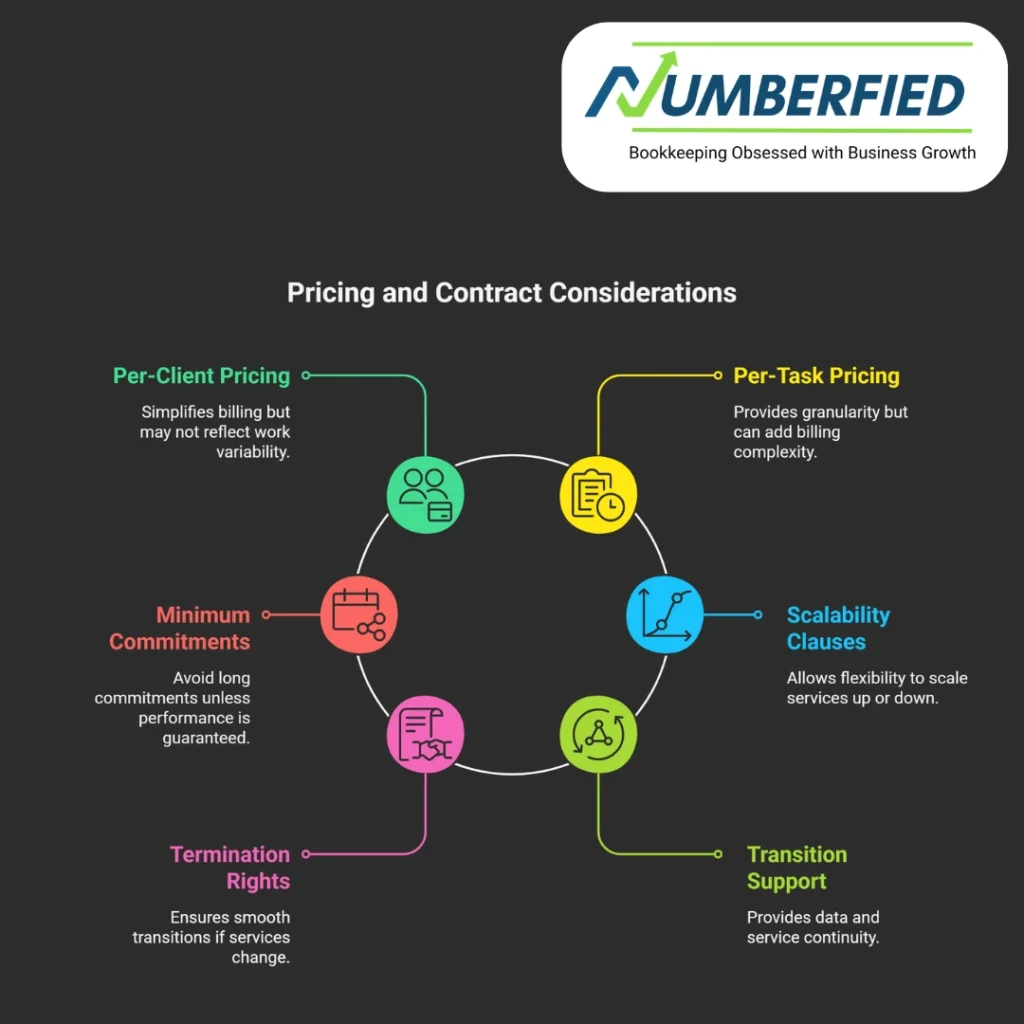
Per-client vs. per-task pricing
Per-client pricing simplifies billing but may not reflect variability in work. Per-task or hourly pricing provides granularity but can add billing complexity. Choose a model aligned with your revenue goals and risk tolerance.
Minimum commitments and scalability clauses
Look for flexible contract terms that allow scaling up or down. Avoid long minimum commitments unless they include strong performance guarantees.
Termination rights and transition support
Ensure the contract includes exit provisions and data transition support so clients experience no disruption if you change providers or bring services in-house.
Actionable Implementation Checklist
Pre-engagement checklist
- Define scope, SLAs, and KPIs.
- Confirm provider certifications and US tax experience.
- Map integrations and data security requirements.
Pilot and validation checklist
- Select representative pilot clients.
- Test reconciliations, reporting, and e-file workflows.
- Collect feedback and adjust processes.
Rollout and measurement checklist
- Stage rollout by client size or industry.
- Monitor KPIs weekly initially, then monthly.
- Conduct quarterly business reviews and optimize pricing.
Case Uses: Who Should Consider White Label Accounting Services?
Accounting firms seeking capacity and specialization
Firms that want to offer niche services such as cost accounting, tax specialties, or forensic accounting can do so quickly using white label accounting services.
Software vendors and payroll companies
Companies selling payroll or fintech products can integrate white label accounting services to provide a full finance platform for customers without building internal accounting teams.
Advisory firms and fractional CFOs
Advisory firms can add bookkeeping, tax prep, and financial reporting under their brand to create end-to-end client experiences that support advisory advice with accurate books.
Common Pitfalls and How to Avoid Them
Underestimating integration work
Plan for metadata mapping, chart of accounts alignment, and bank feed reliability. Underestimating these tasks is a common cause of delays.
Poor governance and lost client trust
Maintain oversight and clear client communication to preserve trust. Clients should not feel they lost access to their data or primary contact.
Neglecting compliance nuances
Ensure the provider understands state-specific payroll tax rules and filing windows. Neglecting these details can lead to penalties and reputational harm.
How Numberfied Supports White Label Accounting Services
Specialized US-focused teams and compliance
Numberfied partners with firms to deliver white label accounting services with teams experienced in US tax and GAAP compliance, ensuring filings and statements meet regulatory standards.
Seamless technology integrations
Numberfied supports QuickBooks, Xero, and common payroll systems, offering API-based integrations and secure data handling that align with client workflows.
Flexible engagement and measurable ROI
Numberfied provides flexible pricing models, pilot programs, and KPI-driven reporting to help firms quantify cost savings and revenue impact.
Conclusion
White label accounting services are a practical way for US businesses and firms to expand service offerings, access specialized expertise, and scale efficiently while maintaining brand continuity. Weigh benefits against privacy, integration, and oversight challenges. Prioritize providers with US compliance experience, robust technology integrations, and transparent governance. Pilot before scaling and measure ROI through direct savings, revenue growth, and improved client satisfaction. For tailored guidance and a pilot program that aligns with your firm’s goals, contact Numberfied to discuss white label accounting services and next steps.
Frequently Asked Questions
What are white label accounting services?
White label accounting services are outsourced accounting, bookkeeping, tax, and related financial services provided by a third party but branded and presented under your firm’s name. They allow you to expand offerings without building full internal teams.
How do white label accounting services handle US tax compliance?
Reputable providers maintain up-to-date knowledge of IRS rules and state tax requirements, manage e-filing, and follow documentation and identity-verification procedures. Confirm the provider’s US tax experience before engagement.
Which accounting platforms are commonly supported?
Common platforms include QuickBooks Online and Desktop, Xero, and NetSuite. Confirm API support and specific Inyroll and banking integrations to ensure smooth workflows.
How do I ensure data security when outsourcing?
Require providers to demonstrate security certifications (SOC 2 or equivalent), encryption practices, access controls, and breach notification procedures. Include security requirements in the contract.
Can I start with a pilot program?
Yes. A pilot lets you validate workflows, integrations, and client communications before a full rollout. Use representative clients and clear KPIs to measure success.
How are pricing models structured?
Pricing can be per-client, per-task, hourly, or subscription-based. Choose a model aligned with predictability, scalability, and the complexity of services you plan to offer.
What governance should I put in place?
Establish SLAs, approval workflows, KPI tracking, and regular review meetings. Include audit rights and escalation procedures to maintain quality and accountability.
How does outsourcing affect client relationships?
When managed properly, outsourcing enhances client service by enabling faster delivery and broader expertise. Maintain communication protocols to ensure clients remain confident in their primary contact and join our brand.
What is the typical onboarding timeline?
Onboarding timelines vary by scope but typically include a discovery phase (1–3 weeks), a pilot (4–8 weeks), and a staged rollout (1–3 months), depending on integrations and client volume.
How do I measure ROI from white label accounting services?
Measure direct cost savings, revenue uplift from new services, efficiency gains (turnaround time, error reduction), and client satisfaction improvements. Use these KPIs to evaluate long-term impact.
Read Also: Why Do Accountants Charge So Much? Exploring Accounting Firm CFO Services