
Introduction
Hiring an Xero bookkeeper can significantly improve how your business manages its finances by streamlining processes, reducing operational costs, and increasing the accuracy of financial data. By leveraging cloud-based tools like Xero, businesses gain real-time visibility into cash flow, automated reconciliations, and efficient reporting without the burden of managing everything in-house. A skilled Xero bookkeeper not only handles day-to-day bookkeeping tasks but also supports compliance, tax preparation, and financial decision-making. This guide provides a practical overview of the benefits, potential challenges, compliance considerations, provider selection criteria, essential tools, onboarding best practices, and how to measure return on investment,t helping you confidently engage a reliable partner like Numberfied.
Key Takeaways
- Cost savings: outsourcing bookkeeping to an Xero bookkeeper often lowers overhead and improves cash flow clarity.
- Expertise and compliance: experienced bookkeepers maintain IRS and GAAP-aligned records.
- Scalability and focus: flexible services expand as businesses grow, enabling leaders to focus on core operations.
- Choose carefully: verify credentials, integration skills, security practices, and communication style.
- Onboarding and ROI: structured onboarding and defined KPIs reveal measurable financial and time returns.
Why a Xero Bookkeeper Matters
Immediate value proposition
A Xero bookkeeper brings structured, accurate bookkeeping using cloud-native workflows. For US business owners, reliable books mean timely tax filing, informed decisions, and fewer surprises during audits. The right provider makes bookkeeping a predictable operational function rather than an ongoing problem.
Who benefits most
Small to mid-size businesses, startups, and scaling enterprises gain the most from an Xero bookkeeper. Organizations with fluctuating transaction volume, remote teams, or a need for cash-flow visibility find outsourced bookkeeping cost-effective and strategic.
How to read this guide
This article combines practical advice, compliance considerations, technology choices, and vendor-selection tips. Actionable checklists and onboarding steps help you confidently move from evaluation to implementation.
Benefits of Hiring a Xero Bookkeeper
Cost savings and predictable pricing
Outsourcing to an aXeroo bookkeeper typically reduces full-time salary, benefits, and training costs. Many firms offer subscription or hourly models that convert fixed payroll into variable expense tied to service level. That predictability supports budgeting and preserves capital for growth activities.
Specialized expertise and clean books
An experienced Xero bookkeeper understands chart-of-accounts design, revenue recognition, and reconciliation best practices. Clean, up-to-date books reduce tax exposure, accelerate month-end close, and improve financial reporting accuracy.
Scalability without hiring cycles
As transaction volume grows, a Xero bookkeeper firm can scale resources quickly. This avoids hiring lag or the need to recruit specialized in-house talent, allowing businesses to expand operations without administrative bottlenecks.
Enabling core focus for leadership
By removing day-to-day bookkeeping tasks from leadership or internal teams, businesses can focus on sales, product development, and customer service. A Xero bookkeeper serves as a finance operations backbone that supports strategic priorities.
Common Challenges and How to Mitigate Them
Data privacy and security
Entrusting financial data to an Xero bookkeeper requires clear security expectations. Require multi-factor authentication, encrypted data transfer, role-based access, and a written data-handling policy. Review provider SOC reports or security certifications where available.
Integration with existing systems
Compatibility between accounting tools, payroll, POS, and CRMs is essential. Confirm a prospective Xero bookkeeper’s experience integrating Xero or other platforms with your ecosystem. Map data flows and test integrations during onboarding.
Maintaining oversight
Outsourcing doesn’t mean losing control. Implement regular reporting cycles, approve key reconciliations, and retain read-only access to live books. A Xero bookkeeper should support transparent dashboards and deliverables that enable governance.
Change management and staff adjustment
Internal staff may experience role shifts. Clear communication about responsibilities and collaboration protocols reduces friction. Include training sessions and a transition period in the contract to smooth the change.
US Compliance: IRS, GAAP, and Regulatory Considerations
IRS filing readiness
A Xero bookkeeper ensures records support IRS filings, including Form 1099s, payroll tax deposits, and business tax returns. Accurate classifications and timely reconciliations reduce audit risk and penalties.
GAAP alignment and financial reporting
For businesses with investors, banks, or regulatory reporting needs, an Xero bookkeeper can maintain GAAP-consistent ledgers and prepare statements suitable for third-party review. Discuss accounting policies and revenue recognition methods upfront.
Sales tax and state compliance
Sales and use tax obligations vary by state and nexus rules. A knowledgeable Xero bookkeeper helps track taxable transactions, manage filings, and maintain documentation for state audits.
Payroll and employment taxes
Payroll compliance is complex. Confirm whether the Xero bookkeeper coordinates with your payroll provider or manages payroll directly. Ensure timely deposits, accurate wage reporting, and support for year-end forms.
Choosing the Right Xero Bookkeeper Provider
Verify credentials and experience
Ask about certifications, years of experience, and industry specialization. A qualified bookkeeper should provide references and examples of similar engagements. Confirm familiarity with Xero workflows if you rely on that platform.
Service scope and SLAs
Define bookkeeping scope, deliverables, turnaround times, and service-level agreements. Establish month-end close timelines, reconciliation standards, and communication expectations to avoid misunderstandings.
Security, insurance, and legal protections
Require proof of professional liability insurance and data protection policies. Include confidentiality clauses and clear ownership of financial records in the contract. A Xero bookkeeper should accept reasonable audit rights and compliance checks.
Pricing model and transparency
Evaluate hourly, fixed, or tiered pricing models. Request a sample statement of work and examples of deliverables. Transparent pricing from a Xero bookkeeper helps avoid scope creep and surprise invoices.
Tools and Integrations: Xero, QuickBooks, and More
When to choose Xero
Xero is strong for cloud-native bookkeeping, bank feeds, and multi-currency needs. A Xero bookkeeper will exploit Xero’s automation features, reconciliation tools, and app ecosystem to reduce manual work.
QuickBooks and hybrid environments
Some businesses use QuickBooks Desktop or Online. A Xero bookkeeper may support QuickBooks or manage conversions between systems. Evaluate conversion costs, historical data needs, and current integrations before changing platforms.
Common integrations
Look for experience with payroll systems, payment processors, POS systems, expense management tools, and CRMs. A Xero bookkeeper should map and test these connections to ensure reliable transaction posting.
Automation and apps
Automation tools reduce repetitive tasks. A Xero bookkeeper will recommend apps for receipt capture, bank reconciliation, invoicing, and expense policies to improve accuracy and speed.
Tax Preparation and Year-End Support
Preparing accurate data for tax advisors
A Xero bookkeeper prepares reconciled ledgers, supporting schedules, and documentation required by tax preparers. Clean books reduce preparation time and minimize the chance of incorrect filings.
Managing estimated tax payments
For pass-through entities and corporations, an Xero bookkeeper can provide timely profit projections and cash forecasts to plan estimated tax payments and avoid underpayment penalties.
Audit readiness and record retention
Maintain records in accordance with the IRS retention schedule. A Xero bookkeeper should produce audit-ready workpapers and provide a clear history of adjustments and reconciliations.
Coordination with CPAs
Establish regular checkpoints with your CPA. A Xero bookkeeper collaborating closely with tax professionals ensures consistent treatment of expenses, depreciation, and tax elections.
Onboarding Process: Step-by-Step
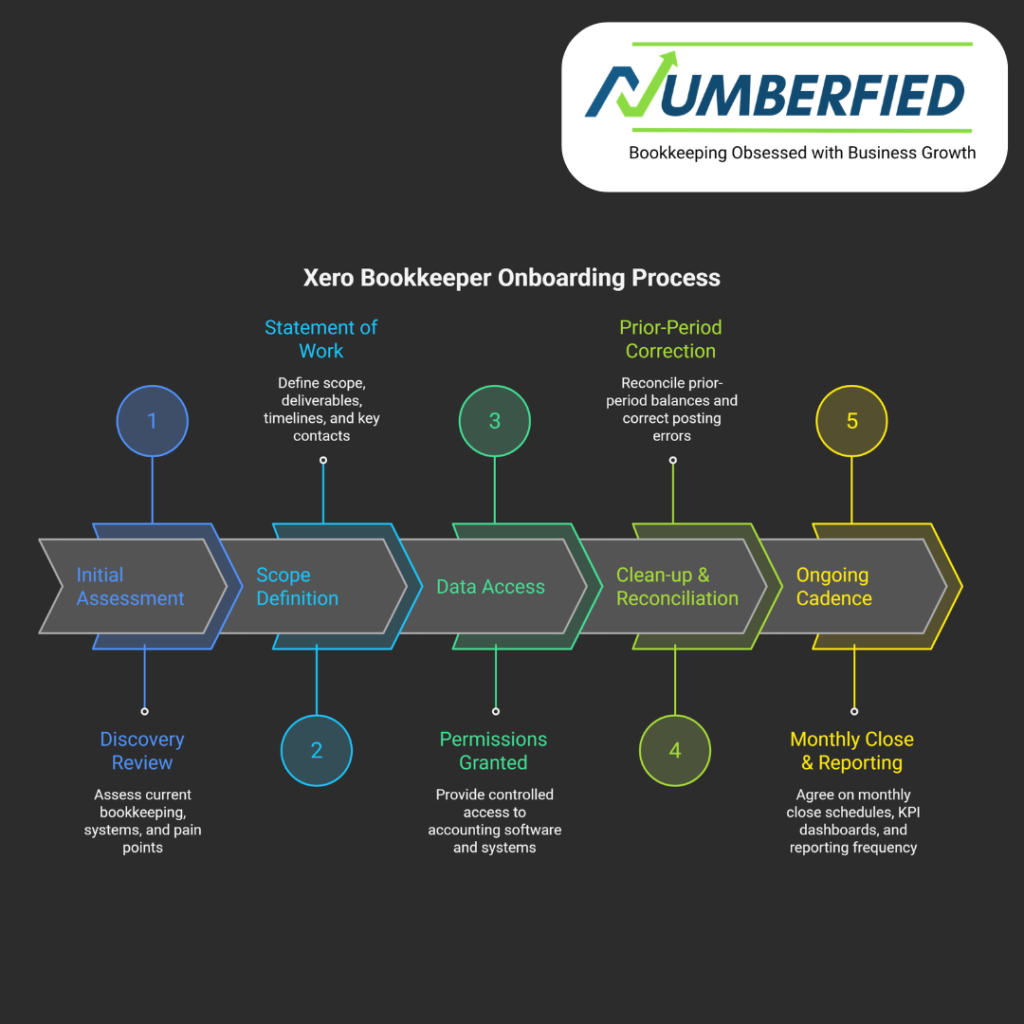
Initial assessment and scope definition
Begin with a discovery review of current bookkeeping, systems, and pain points. Define scope, deliverables, timelines, and key contacts. A Xero bookkeeper should provide a clear statement of work from this assessment.
Data access and permissions
Grant controlled access to accounting software, banks, and relevant systems. Establish role-based permissions and require security protocols, such as multi-factor authentication, during Xero bookkeeper onboarding.
Clean-up and reconciliation phase
Most engagements include a clean-up period to reconcile prior-period balances and correct posting errors. Track progress with milestones and accept a detailed transition report from the Xero bookkeeper.
Ongoing cadence and reporting
Agree on monthly close schedules, KPI dashboards, and frequency of meetings. A Xero bookkeeper should deliver consistent reports that support management decisions and tax planning.
Measuring ROI from a Xero Bookkeeper
Define KPIs up front
Key metrics include month-end close time, bank reconciliation lag, error rates, tax preparation time, and finance-related labor hours saved. A Xero bookkeeper should help establish baseline measurements for each KPI.
Direct and indirect cost savings
Savings come from reduced payroll, fewer tax penalties, better cash management, and time reallocated to revenue-generating activities. Quantify these savings to evaluate net benefit after service fees.
Timeline for payback
Many businesses see measurable improvements within three months of onboarding an Xero bookkeeper, with full ROI within six to twelve months,s depending on the prior condition of books and transaction complexity.
Report examples and review cycles
Require monthly ROI summaries and quarterly strategic reviews. A Xero bookkeeper should present tangible improvements and adjustments to service levels in response to changing volume.
Negotiating Contracts and Service Levels
Define exit and transition terms
Include clear termination clauses and data return policies. Ensure transition support is part of the contract so knowledge transfer occurs smoothly if you change providers or insource bookkeeping later.
Performance incentives and penalties
Consider clauses tying part of the payment to on-time close rates or reconciliation performance. A Xero bookkeeper should accept reasonable performance expectations tied to service fees.
Flexibility for growth
Contract for scalable pricing tiers or add-on services. As your business grows, an Xero bookkeeper should provide options to expand services without complex renegotiation.
Regular contract reviews
Schedule annual contract reviews to adjust scope, pricing, and KPIs. This keeps the relationship aligned with changing business needs.
Practical Tips: Getting the Most from Your Xero Bookkeeper
Establish clear communication channels
Designate primary contacts, set meeting cadences, and use shared task tracking. Clear communication reduces misunderstandings and accelerates resolutions.
Standardize documentation and processes
Create a simple playbook for recurring transactions, expense policies, and approval workflows. A Xero bookkeeper will operate more efficiently with consistent inputs.
Request training for internal staff
Ask the Xero bookkeeper to provide short training sessions for anyone interacting with accounting systems. This ensures accurate data capture and reduces downstream errors.
Use KPI dashboards actively
Review dashboard insights regularly and adjust operations accordingly. A Xero bookkeeper should supply actionable metrics, not just raw numbers.
Conclusion and Next Steps
Engaging an Xero bookkeeper can yield measurable benefits in cost reduction, compliance, scalability, and operational focus. While challenges such as security and integration require careful attention, structured onboarding, clear SLAs, and ongoing oversight mitigate risks. For US business owners seeking reliable bookkeeping that supports tax readiness and strategic decision-making, professional bookkeeping services bring significant value.
To explore how an Xero bookkeeper can fit your organization, request a consultation with Numberfied for a tailored assessment and proposal. Contact Numberfied to begin an efficient, secure onboarding process and measure the ROI from improved financial operations.
Frequently Asked Questions
What is an Xero bookkeeper, and why choose one?
A Xero bookkeeper is a professional who manages financial records using Xero or equivalent cloud accounting workflows. Choose one for cloud-native automation, efficient reconciliations, and scalable service models suited to modern business needs.
How does a Xero bookkeeper improve tax preparation?
They maintain reconciled ledgers, prepare schedules, and document supporting transactions, thereby shortening tax-prep time and reducing the risk of errors or missed deductions during IRS filings.
Can a Xeroo bookkeeper handle payroll and sales tax?
Many bookkeepers coordinate payroll with payroll providers or manage payroll directly and handle sales tax filings. Verify specific capabilities and state compliance experience when selecting a provider.
What security measures should I expect?
Expect multi-factor authentication, encrypted data transfer, role-based permissions, and written data-handling policies. Request evidence of security controls and insurance as part of the vetting process.
How long does onboarding take?
Onboarding duration varies: simple setups can take two to four weeks; complex clean-ups may require several months. Agree on a timeline and milestones with your Xero bookkeeper before starting.
Will a Xeroo bookkeeper replace my CPA?
No. A Xero bookkeeper handles day-to-day accounting and record-keeping while CPAs focus on tax strategy, filings, and advisory services. Collaboration between both improves outcomes.
How do I measure the ROI of bookkeeping services?
Measure KPIs like time-to-close, reconciliation lag, tax preparation hours, and reduced penalties. Compare labor and error costs before and after engaging an Xero bookkeeper to quantify ROI.
What pricing models are common?
Bookkeepers often use hourly rates, fixed monthly packages, or tiered pricing based on transaction volume and service scope. Request a detailed statement of work and pricing transparency.
Can an Xero bookkeeper help with cash flow forecasting?
Yes. Many provide cash flow reports and scenario modeling to inform working capital decisions and support short-term financing or investment planning.
How do I switch providers or insource later?
Negotiate clear data return and transition clauses in the contract. A professional Xero bookkeeper will provide book exports, supporting schedules, and transition assistance to minimize operational disruption.
For personalized guidance and a professional assessment of how an Xero bookkeeper can help your business, contact Numberfied to schedule a consultation.
Read Also: Why Numberfied’s Bookkeeping Accounting Service Is Your Small Business’s Secret Weapon