

Introduction
The digital landscape is undergoing a massive transformation, driven by the rapid evolution of artificial intelligence. While this technology promises to revolutionize how organizations protect their data, it also introduces unprecedented risks. In the modern tech ecosystem, the integration of AI in cybersecurity has become a critical focal point for enterprise defenders and malicious actors alike.
According to a seminal analysis by CNBC, while AI has a bigger role in cybersecurity, hackers may benefit the most from its democratization. This dual-use dilemma means that the exact same machine learning models used to detect fraud are being reverse-engineered to bypass traditional security perimeters. For growing businesses, understanding this shifting dynamic is no longer optional- it is a requirement for survival.
The Evolution of AI in Cybersecurity and Modern Defense
The traditional model of digital defense relied heavily on static signatures- pre-defined rules designed to spot known malware or suspicious behaviors. However, as cyber threats grow more fluid, enterprise infrastructure demands dynamic protection. Implementing AI in cybersecurity allows security systems to transition from reactive monitoring to proactive threat forecasting.
Machine learning algorithms excel at processing vast quantities of data at scale. By analyzing network traffic, user access logs, and system behaviors in real-time, defensive AI establishes a baseline of “normal” operations. When an anomaly occurs- such as an unauthorized data exfiltration attempt or an unusual late-night server access- the system can isolate the threat immediately, long before a human analyst could review the alert.
This automation is particularly vital for fraud protection. Financial institutions and e-commerce platforms utilize predictive modeling to evaluate transaction risks in milliseconds. By assessing variables like geographic location, device fingerprints, and spending patterns, these systems block fraudulent activity without disrupting the legitimate user experience.
How Cybercriminals are Weaponizing Artificial Intelligence
Despite the massive advantages AI brings to corporate defenders, the barrier to entry for complex cyberattacks has dropped significantly. The core challenge highlighted in the CNBC report is the democratization of advanced computing tools. Today, bad actors do not need extensive programming expertise to launch sophisticated operations; they can simply leverage specialized algorithms to do the heavy lifting.
The Rise of Hyper-Personalized Phishing
Historically, phishing emails were relatively easy to spot due to poor grammar, generic greetings, and awkward phrasing. Generative text models have completely eliminated these tells. Hackers now use automated systems to scrape public data and professional profiles, generating highly convincing, localized, and context-aware communications that achieve much higher open rates than manual campaigns.
Automated Vulnerability Discovery
Instead of a human hacker spending days manually probing a network for open ports or unpatched software, autonomous AI agents can scan thousands of systems simultaneously. These tools identify security gaps, select the optimal exploit payload, and execute the breach at machine speed. This drastically compresses the time window that security teams have to discover and patch a vulnerability.
Polymorphic Malware Development
Advanced malicious software can now use machine learning to alter its underlying code structure on the fly. By subtly changing its digital signature while maintaining its core objective, polymorphic malware easily evades legacy antivirus tools that rely on matching known definitions.
Balancing the Equation: Proactive Fraud Protection Strategies
To counter an adversary operating at network speed, organizations must adopt a multi-layered security framework that prioritizes data integrity and absolute identity verification. Relying strictly on basic firewalls and passwords leaves an organization fundamentally exposed to automated threats.
Securing vulnerable communication channels is an essential first step. Businesses must implement strict verification protocols for data transmission, system access, and user authentication. This is where specialized data management platforms provide an essential layer of friction against attackers. Utilizing tools that validate operational data inputs helps mitigate the risk of automated injection attacks and identity spoofing.
For businesses looking to reinforce their operational perimeters, tracking system metrics and verifying communication validity is paramount. Platforms like Numberfied specialize in structured data validation and telecommunication routing security, ensuring that operational loops remain closed to unauthorized external inputs. By integrating clean data streams into your infrastructure, you prevent the data poisoning tactics that hackers frequently use to confuse automated defensive systems.
The Human-AI Hybrid: The Future of Enterprise Resilience
While automation handles the initial triage of security events, human oversight remains irreplaceable. Artificial intelligence operates on mathematical probabilities, not genuine contextual understanding. It can easily misinterpret a unique, legitimate business operation as a malicious attack, leading to costly operational downtime.
The most resilient organizations utilize a hybrid model: AI handles the scale, speed, and repetition of data ingestion, while skilled human analysts provide the strategic reasoning and forensic investigation. This approach ensures that low-level alerts are resolved automatically, freeing up internal security personnel to focus on high-level risk management and architecture optimization.
Furthermore, building corporate resilience requires a culture of continuous education. Because social engineering attacks have become incredibly polished due to text-generation tools, employees must be trained to verify unusual internal requests through secondary, out-of-band communication channels rather than relying solely on email confirmation.
Conclusion
The deployment of AI in cybersecurity represents a permanent shift in the digital arms race. As detailed by CNBC’s reporting on the expanding role of technology in crime, the advantages provided to hackers require a complete rewrite of traditional corporate defense playbooks.
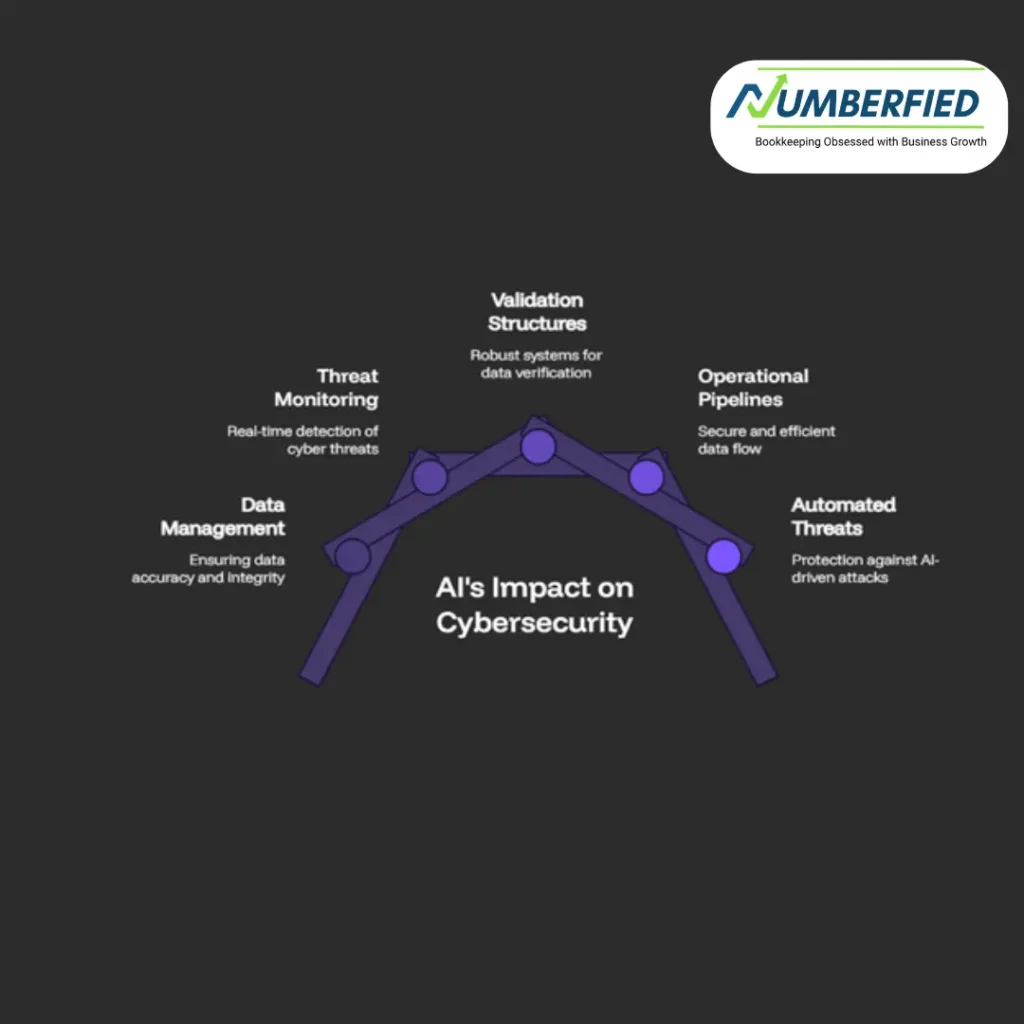
Surviving in this environment demands absolute precision in data management, real-time threat monitoring, and robust validation structures. By partnering with dedicated data and verification platforms like Numberfied, businesses can ensure their operational pipelines remain accurate, authenticated, and secure against automated threats.
Read Also: Best outsourced CPA for startup Your Key to Financial Success
Frequently Asked Questions
What is the primary role of AI in cybersecurity?
AI is primarily used to analyze massive datasets, automate incident responses, detect behavioral anomalies in real-time, and flag potential fraud faster than manual human review allows.
How are hackers utilizing AI to bypass traditional security?
Hackers use machine learning to automate network scanning, generate highly convincing phishing emails, and create polymorphic malware that changes its code structure to avoid detection by legacy antivirus programs.
Why did the CNBC report state that hackers might benefit the most from AI?
The technology democratizes cybercrime. It lowers the technical barrier to entry, allowing less sophisticated bad actors to deploy automated, high-level attacks at a scale and speed that defenders struggle to match.
What is polymorphic malware?
Polymorphic malware is malicious software that uses artificial intelligence to alter its identifiable traits (like its file signature or encryption keys) each time it replicates, making it invisible to standard signature-based detection tools.
How does AI improve business fraud protection?
It evaluates transactional data, user location, and device fingerprints in real-time to calculate risk scores, blocking fraudulent activities instantly without creating friction for legitimate consumers.
Can AI fully replace human cybersecurity professionals?
No. AI lacks context and is prone to false positives or manipulation via data poisoning. The ideal security posture combines automated speed with human strategic reasoning.
What is a data poisoning attack?
A data poisoning attack occurs when malicious actors inject corrupt or misleading data into the training datasets of a machine learning model, causing the system to misidentify threats or allow unauthorized access.
How does Numberfied assist in a comprehensive security strategy?
Numberfied provides robust data validation and routing verification frameworks, ensuring corporate communication loops and operational data points remain authenticated against automated external manipulation.
What is the danger of AI-generated phishing?
Generative models allow attackers to quickly draft highly personalized, professional, and contextually accurate messages at scale, making it difficult for employees to distinguish fake emails from legitimate corporate correspondence.
What is the first step a business should take to defend against AI threats?
Organizations should implement a zero-trust architecture, enforce multi-factor authentication, use clean data validation streams, and provide updated security awareness training tailored to modern automated social engineering tactics.